The impression of remembered light
It is a glorious summer’s night, but the canal is officially closed. Join us tonight, as we ponder over what this shutdown means for permanent liveaboards and the fragile ecosystem left behind. Plus, we playfully ask: does the canal miss us when we are gone?
Journal entry: 6th August, Thursday
“From here, the alders look black The sky behind them afire With the sun’s setting. Ducks swim through Clouds of baby pink The fish are rising. The water is warm...

 Apple Podcasts
 Spotify
 Amazon Music
 Castbox
 Podchaser
 iHeartRadio
 PlayerFM
 Goodpods
 TuneIn
 Podcast Addict
 Castro
 PocketCasts
 RSS Feed
 YouTube
 It is a glorious summer’s night, but the canal is officially closed. Join us tonight, as we ponder over what this shutdown means for permanent liveaboards and the fragile ecosystem left behind. Plus, we playfully ask: does the canal miss us when we are gone?
Journal entry:
6th August, Thursday
“From here, the alders look black
The sky behind them afire
With the sun’s setting.
Ducks swim through
Clouds of baby pink
The fish are rising.
The water is warm around my toes
And the tea has been drunk
Long ago.”
Episode Information:
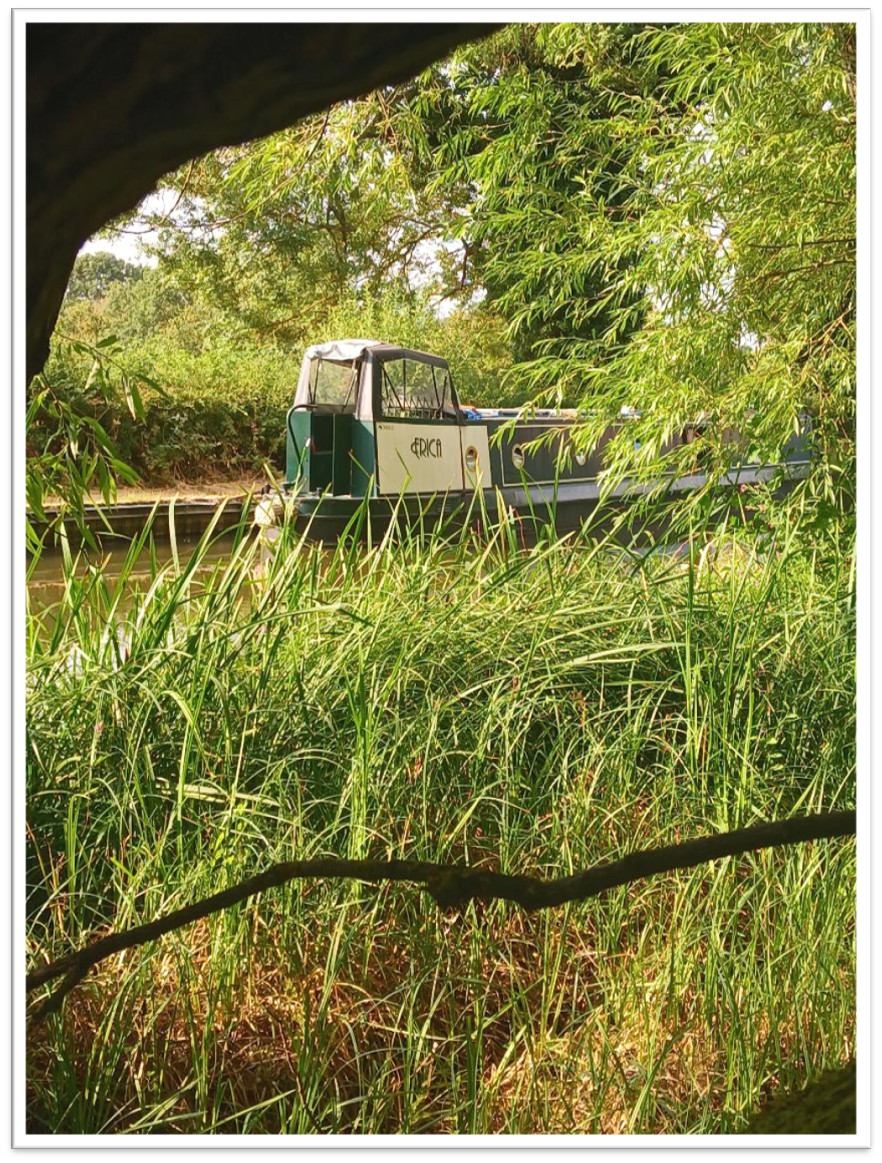
The Erica earlier this summer
In this episode I read a very short extract from Tom Rolt’s Narrow Boat published by published by Eire and Spottiswoode in 1944. I also read my ‘Sometimes the canal is silent.’
Listener, Lee Thomas from Colorado (USA), shares with us the view she has from her cabin high in the foothills of the Colorado Mountains.
With special thanks to our lock-wheelersfor supporting this podcast.
Ana McKellar
Susan Baker
Mind Shambles
Clare Hollingsworth
Kevin B.
Fleur and David Mcloughlin
Lois Raphael
Tania Yorgey
Andrea Hansen
Chris Hinds
Chris and Alan on NB Land of Green Ginger
Captain Arlo
Rebecca Russell
Allison on the narrowboat Mukka
Derek and Pauline Watts
Anna V.
Orange Cookie
Mary Keane.
Tony Rutherford.
Arabella Holzapfel.
Rory with MJ and Kayla.
Narrowboat Precious Jet.
Linda Reynolds Burkins.
Richard Noble.
Carol Ferguson.
Tracie Thomas
Mark and Tricia Stowe
Madeleine Smith
General Details
The intro and the outro music is ‘Crying Cello’ by Oleksii_Kalyna (2024) licensed for free-use by Pixabay (189988).
Narrowboat engine recorded by 'James2nd' on the River Weaver, Cheshire. Uploaded to Freesound.org on 23rd June 2018. Creative Commons Licence.
Piano and keyboard interludes composed and performed by Helen Ingram.
All other audio recorded on site.
Become a 'Lock-Wheeler'
Would you like to support this podcast by becoming a 'lock-wheeler' for Nighttime on Still Waters? Find out more: 'Lock-wheeling' for Nighttime on Still Waters.
Contact
- Facebook at https://www.facebook.com/noswpod
- Instagram: https://www.instagram.com/nighttimeonstillwaters/
- Bluesky: https://bsky.app/profile/noswpod.bsky.social
- Mastodon: https://mastodon.world/@nosw
I would love to hear from you. You can email me at nighttimeonstillwaters@gmail.com or drop me a line by going to the nowspod website and using either the contact form or, if you prefer, record your message by clicking on the microphone icon.
For more information about Nighttime on Still Waters
You can find more information and photographs about the podcasts and life aboard the Erica on our website at noswpod.com.
00:00 - Introduction
00:26 - Journal entry
01:00 - Welcome to NB Erica
02:08 - News from the moorings
07:16 - Cabin chat
13:27 - The impression of remembered light
28:41 - Extract from Tom Rolt's Narrow Boat
32:10 - 'Sometimes the canal is silen' by Richard Goode
32:39 - Night-view through the window from Lee Thomas
34:52 - Signing off
35:08 - Weather log
JOURNAL ENTRY
6th August, Thursday
“From here, the alders look black
The sky behind them afire
With the sun’s setting.
Ducks swim through
Clouds of baby pink
The fish are rising.
The water is warm around my toes
And the tea has been drunk
Long ago.”
[MUSIC]
WELCOME
The canal still stirs with the ripple and ring of rising fish in the half-light towards darkness. The summer twilight is steaked with gunmetal blue and barely water. A few gnats dance lazily. The bankside rushes hold their breath.
This is the narrowboat Erica narrowcasting into the darkness of a high summer night to you wherever you are.
You made it. It's such a beautiful night, I was hoping you could come and enjoy it. Just look at how still the water is and how the clouds look like rapids in an airborne river! Make yourself comfortable. The kettle is on and the biscuit barrel is full, and welcome aboard!
[MUSIC]
NEWS FROM THE MOORINGS
We have now entered Lamas-tide and the slow drift towards Michaelmas.
We had a welcome spell of cooler weather this week – although by cool, the temperatures were closer to what we normally expect for a very nice August day! I think 22°C (71°F) was the lowest. But everything still remains dry. A night of drizzle scarcely dampened the ground, by 8 o’clock the following morning, the ground was dry enough to sit on. Dust hangs everywhere, soil and grit blown off the fields. When doing any work outside, everything feels gritty.
Everywhere is parched, baked with the browns of hessian, calico, and caramel. The high bank beside us is tinder dry. The rush of flowers, dried stalks and desiccated flowerheads that rattle like skeleton bones as you walk. Only the hardiest plants remain in flower; houndstooth, ragwort, yarrow, and saxifrage. Even the thistles and knapweed are struggling.
This should be the time of ‘Lamas growth.’ The high summer spurt of new-growth, the last pulse of bounty, for the harvest. But among the canopies above us, new green is not easy to spot. Autumnal colours are already showing and leaves fall crisp along the paths. At times like these, life draws itself in: conserves, protects.
But colour there is, along the water’s edge. Loosestrife flares, now burning low, marshwort spikes, willow herb flowers among its smoke, soft woollen balls of agrimony. Is it me, or maybe it is just around here, but is balsam not so prevalent this year? A few years back, I seemed to spy it’s warm yellowy-orange everywhere, floating among the deep reed-greens like Japanese paper lanterns.
The ducklings have grown. One family of six still close-knit visits us daily. Sometime mum is with them, often not. The year has also been good for moorhen chicks. I spotted a new one (probably about a week or two old) this afternoon. As brutal as this summer has been for them weatherwise, at least they seem to have been spared the carnage of the last couple of years.
Last weekend, I spotted a pike. I was sitting on the stern deck watching the sun sink and a serpentine prehistoric shape rose out of the water. It was literally a couple of feet away from my foot, and was one of those occasions where your brain scrambles through every combination of gestalt patterns to make sense of what you are seeing! I was aware of impression more than detail. A long snout, mouth open, the impression of a cold eye, almost reptilian, crocodile. The writhe of a long body the colour of ancient water, whose motion was as fluid as the liquid in which it swam. An edge of fin as it once more submerged. More than anything, there was a strong sense of presence – not warm, not welcoming, just there. The part of it that broke the surface was easily a foot and a half long. And that feeling of 'presence' remained long after it had submerged and the rings it had left in the water had disappeared.
[MUSIC]
CABIN CHAT
[MUSIC]
THE IMPRESSION OF REMEMBERED LIGHT
Well, the canal that we are on has officially been closed due to low water. The notification came into effect last Monday. I can’t say it was a surprise. Rumour and prognostications have been rumbling for the past couple of months – ever since that hot spell in May. Neighbouring boaters who have stopped over to work on their boats, but need to be elsewhere on the system have been frantically racing against time. The problem was worsened, by the lack of clear information – not that anyone was really in a position to offer it. We not only didn’t know when it would be closed (although, the lack of rain and the clear drop in water level meant it would pretty much be an inevitability, we also didn’t know how much of the canal would be closed. It turned out to be the whole south section.
I was talking to one boater just before it closed. She has work on her boat booked into a boatyard on a different canal at the beginning of October. In geographical terms, it is not far –about two days solid cruising. However, rightly she was worried and in a quandary about what to do. Should she stay put and hope for enough rain to come between now and October for the stretch to be reopened? Bearing in mind, that we need a LOT of rain and also time for that water to come down to us. Her problem was also that a flight of locks on a different canal that she needed to go through were also on the list for possible closure. Should she risk staying here and then get trapped? If she went, there was a very real chance that she could end up being trapped between closures along a stretch that was distinctly lacking the facilities or services that she needed. We talked over all the options, the plans B, C, and D. It was all guess work under the unblinking sun in its basin of blue. Like most liveaboard boaters, she was extremely capable with a happy-go lucky ‘can-do’ spirit. Nevertheless, we both were aware of the cloudless sky and the way that the canal level seemed to drop daily. Maggie’s splash pool from which she swims was now just a patch of dry earth. We begin to keep an eye on boats left by owners (for one reason or another) to make sure their ropes are loose enough to allow their boat to settle with the water.
Weather forecasts have not been helpful in decision making either; with little sign of significant rain. Even the three or four times in the past two months, the forecast has indicated rain for this area, it actually only occurred once, and, as welcome as that was, that was more of a heavy drizzle than a proper downpour. Although, as other areas have experienced first-hand, torrential downpours come with their own hazards and are often, as far as replenishing reservoirs is concerned can be as ineffective as a light shower. Watching the weather radar can be a frustrating thing for this area. Thick bands of rain either fizzle out just before they hit us or part and pass either side of us.
In the end, she decided to go. Drydock bookings are like tickets to an Oasis gig – hard to get and therefore more precious than their face value would suggest. Our local drydock already needs to be booked a year in advance – and this current situation is likely to make booking a slot in the future even harder. If you have managed to get a slot, you don’t want to miss it.
Three days later, the canal was closed. She would have had plenty of time to get off it and a good way to her destination (just this side of that other problematic set of locks). It would have been the decision I would have taken, if it was me in her place. But it does mean she is stuck on a long pound that is very low on water and I have heard reports of boats frequently grounding.
Canal closure means exactly what it sounds like. All passage on it is effectively prohibited, even between locks. This doesn’t just relate to narrowboats and river cruisers, but also to canoeists, kayakers and paddle borders, although I have seen the latter two still using it. In fairness to them, unless you happen to subscribe to the normal digital channels or subscribe to the CRT notifications, it easy to not be aware of a closure. In fact, in the end, I had to do a Google search to verify that the closure had actually gone ahead. The notification that I got was buried under a sea of emails listing other such notifications and, even though was keeping my eyes open, completely missed it!
Alongside the number of closures, the Canal and River Trust have also lifted the 14 day rule which requires a boat to move on after 14 days. It is another attempt to try to alleviate the drastic water shortage. This has been an unprecedented move and indicates the seriousness of the situation.
All this clearly has a huge impact on those using the canals, but my greatest worry is its effect upon the life within it, though. There are already many reports of dead or dying fish being spotted. The water temperature is high, which means less oxygen is dissolved in it than if it was cold. The lack of boat movement, while helping to regulate water loss, also means that an important means of oxygenation is lost. Boat propellors provide a significant service in oxygenation. Factors like these combine to create a perfect storm for the creation of stagnant water unable to sustain life. As much as I enjoy watching the carp rise and porpoise, it isn’t a good sign and I am aware that this is not just play or exuberance.
The towpath remains open, though; it is just the water that has fallen silent and glassy. In this heat, in this quietness, it is difficult not to think as if the canal was sleeping; dozing in the heat of high summer. The flicker of damselflies, spirit-blue and bold, dance and dart among the clustering arrowheads that rise from the shallows with their heron-footed leaves. Duckweed gathers in lime-green vicarage-tea-party, lawns, with no boat to disperse it – although our local ducks make a good meal from it. It’s packed with protein and essential amino acids and iron for them. Damselflies jump from raft to raft, daring the carp and perch to have a go. The moorhen chicks are nearly full grown now. Though their mothers still hiss like leaky cylinder cocks if we come too close.
They don’t miss us much; we who glide past their complicated lives in a miasma of colour, diesel fumes, and thrashed water. Well, maybe a few ducks and swans might do. Becoming aware of a sense of omission, a void. The tasty titbits that fall like rain upon the water when they tap with their beaks on a sleeping hull. But for the most part, we are not missed, and nor should we be. They have lives that are rich and full, and our noisome passings are one less worry to worry about.
But does the canal miss us? Does it miss the gentle flow of currents we create? The unseen micro eddies, that stir its hidden heart where snails graze and larvae drift among the flowing weeds and decay? Does it miss the plunge and spurt of water as an empty lock chamber is filled? Does it miss the magpie rattle as paddles are opened and gates swung open? Does it miss the sweeping clouds of silt that lift and swirl in cloudy waters and then slowly settle with every passing boat? Does it miss us? Does it miss the way the water from each passing bow laps along its edges like dog’s tongue, making the reeds and rushes purr? Does it miss the flick of fish; carp dart, roach rush, the flash of perch and starling-whirl of minnow as the water quakes and surges ahead of an oncoming boat. Live long enough on the canal and you too will become aware of that slight sway and knock of the boat at mooring that can come, sometimes 10 minutes before another boat appears – depending on where you are.
Tell me, does it miss us?
The lock’s bywash is silent, barely a trickle of water tickles it was down the centre of its algae-slick, concrete chute. Just a few months ago, I watched a drake mallard struggle to keep upright in its racing torrent and how its roar greeted me before I could even see it. A jumble of sticks lies across the mouth. A dam of sorts, that has given up hope of ever finding employment. Blue bottles and horse flies stop to drink. Where has all the water gone? A dark line along the Armco and bankside pilings charts the tidemark of normal depth. It floats a good four to five inches above the current level and is about the only almost straight line that you will find around here. It has already risen a little, in less than a week. It’s working, but it’s a fragile gain. There is still sometime yet to go.
And the canal lies quiet and inscrutable, as it always does. It steals the sky with its sun and clouds and rippling trees and sedge and gives it to the ducks to paddle through. It’s mirrored surface always alive, always moving. We prefer our mirrors dead and the reflections they give lifeless and unmoving. The canal knows better. “Perfection is not complete,” says the Dao de Jing. “Perfect mirrors are not perfect,” says the canal. The imperfections, the omissions, the work still to be done is where the life is; where growth comes.
But this hiatus is but a momentary thing. This old canal has known longer periods without traffic. Times when it was silent to boats and lay, neglected and discarded to the owls and the rooks, nettle and cow-parsley. In 1945, this part of the canal was declared unnavigable, choked with silt and vegetation. A few years before that, Tom Rolt visited it and wrote
[READING]
There are photographs from the late 1950s in which water cannot be seen at all.
If the canal remembers, it remembers these unpeopled times too.
But I wonder too, if it does miss us, for all the noise and chaos we bring? These gentle stilled waters, strangely quiet, strangely untroubled. Perhaps it does, in some way. Perhaps in the swallow swoop and the botherations of geese, it recalls other noises, other disturbances. The shift of water under steel hull. The impression of remembered light as sunlight falls on falling water.
And of course, we haven’t gone anywhere, really. We are still here. Just not in the ways – or perhaps places – we were. The canal still carries us, as effortlessly and as lightly as the thistle down that rolls upon its surface. The canal still bears our weight and carries our lives. We and the canal are still part of each other's lives.
“Sometimes,
The canal is silent
Biding time
Keeping counsel.
Don't ask
Let things be.
At other times,
It reaches out
With whispers
That sing soft and slow
Holding memories
Of old friends.”
[Richard Goode, 2026]
[MUSIC]
NIGHT VIEWS (THROUGH YOUR WINDOW)
With thanks to Lee Thomas (Colorado, USA)
SIGNING OFF
This is the narrowboat Erica signing off for the night and wishing you a very restful and peaceful night. Good night.


