The Gentleness (of the shortening days)
A welcome breeze plays among the reeds and carves ripples on the canal. Tonight, the Erica is moored on a perfect summer’s night. We welcome you to join us as enjoy the quiet and go searching for older attitudes to summer, the shifting dates of Midsummer's Eve, and just why Midsummer Night’s Dream was so unsummery.

 Apple Podcasts
 Spotify
 Amazon Music
 Castbox
 Podchaser
 iHeartRadio
 PlayerFM
 Goodpods
 TuneIn
 Podcast Addict
 Castro
 PocketCasts
 RSS Feed
 YouTube
 A welcome breeze plays among the reeds and carves ripples on the canal. Tonight, the Erica is moored on a perfect summer’s night. We welcome you to join us as enjoy the quiet and go searching for older attitudes to summer, the shifting dates of Midsummer's Eve, and just why Midsummer Night’s Dream was so unsummery.
Journal entry:
10th July, Friday
“Sitting chatting over a mug of tea
On the stern of the boat
The sound of music and children playing
A swirl of energy at the end of day.
Voices float across the water
That dances with light.
A mother with six newly hatched ducklings
The sun sinks behind Horse Hill.”
Episode Information:
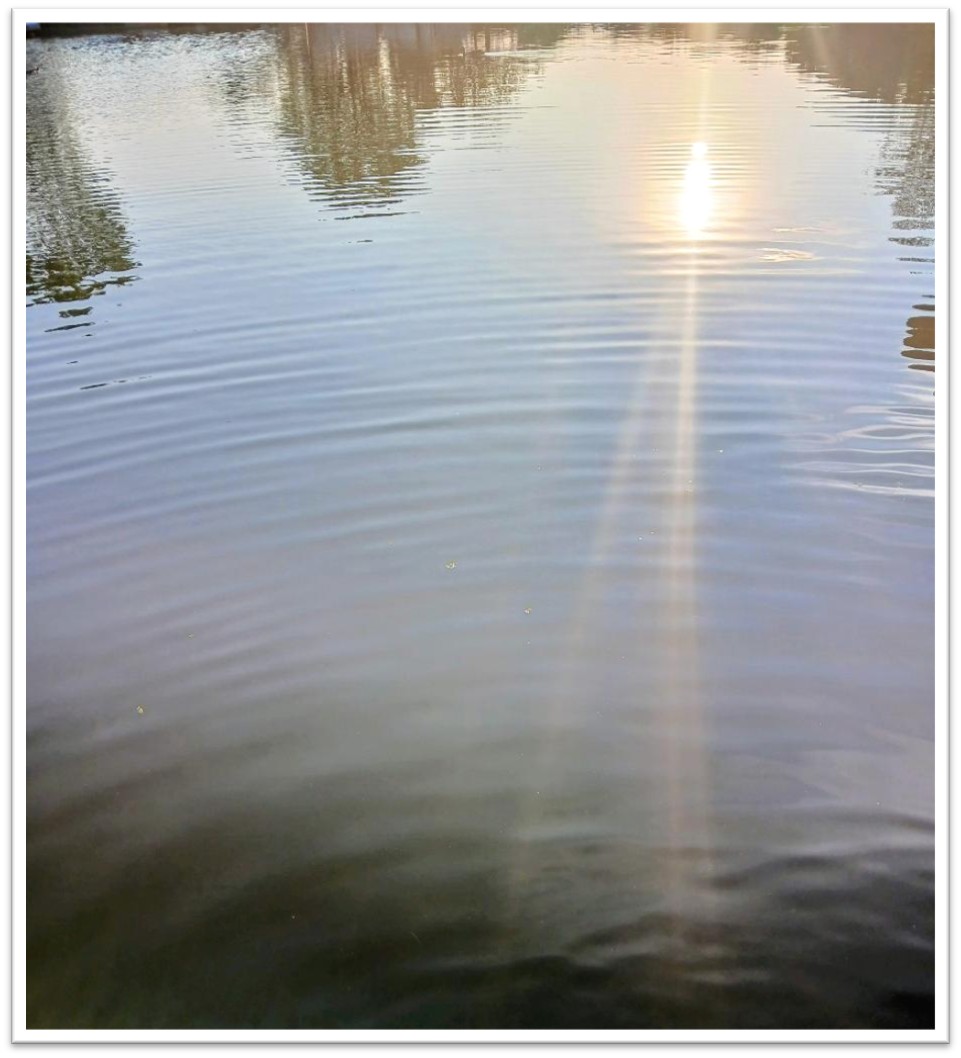
A view from my feet (almost!)
In this episode I read short extracts from Miles Hadfield’s (1950) An English Almanac published by Dent, and Alexandra Harris’ (2015) Weatherland: Writers and artists under English skies published by Thames and Hudson.
I also refer to Hana Videen’s (2022) The Word Hord: Daily life in old English published by Princeton University Press, Eleanor Parker’s (2022) Winters in the World: A journey through the Anglo-Saxon year published by Reaktion Books, and Lia Leendertz’s (2024) A Year in Story and Song: A celebration of the seasons published by Hatchette UK.
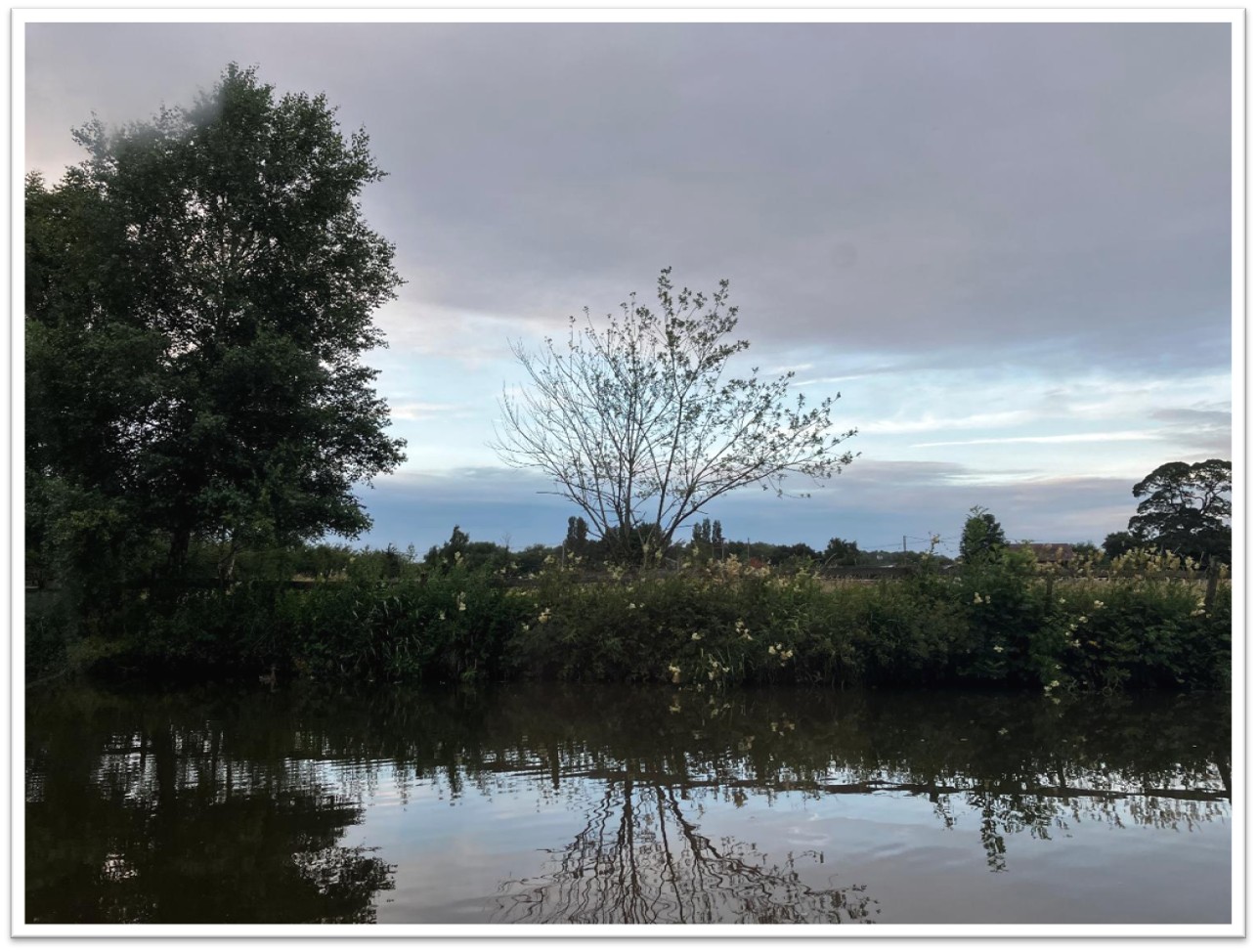 Karen Politte's photograph taken from the window of Dera Rosa which she describes in 'Night Views'.
You can find Karen and Jason's YouTube channel here: Just Two People.
With special thanks to our lock-wheelersfor supporting this podcast.
Ana McKellar
Susan Baker
Mind Shambles
Clare Hollingsworth
Kevin B.
Fleur and David Mcloughlin
Lois Raphael
Tania Yorgey
Andrea Hansen
Chris Hinds
Chris and Alan on NB Land of Green Ginger
Captain Arlo
Rebecca Russell
Allison on the narrowboat Mukka
Derek and Pauline Watts
Anna V.
Orange Cookie
Mary Keane.
Tony Rutherford.
Arabella Holzapfel.
Rory with MJ and Kayla.
Narrowboat Precious Jet.
Linda Reynolds Burkins.
Richard Noble.
Carol Ferguson.
Tracie Thomas
Mark and Tricia Stowe
Madeleine Smith
General Details
The intro and the outro music is ‘Crying Cello’ by Oleksii_Kalyna (2024) licensed for free-use by Pixabay (189988).
Narrowboat engine recorded by 'James2nd' on the River Weaver, Cheshire. Uploaded to Freesound.org on 23rd June 2018. Creative Commons Licence.
Piano and keyboard interludes composed and performed by Helen Ingram.
All other audio recorded on site.
Become a 'Lock-Wheeler'
Would you like to support this podcast by becoming a 'lock-wheeler' for Nighttime on Still Waters? Find out more: 'Lock-wheeling' for Nighttime on Still Waters.
Contact
- Facebook at https://www.facebook.com/noswpod
- Instagram: https://www.instagram.com/nighttimeonstillwaters/
- Bluesky: https://bsky.app/profile/noswpod.bsky.social
- Mastodon: https://mastodon.world/@nosw
I would love to hear from you. You can email me at nighttimeonstillwaters@gmail.com or drop me a line by going to the nowspod website and using either the contact form or, if you prefer, record your message by clicking on the microphone icon.
For more information about Nighttime on Still Waters
You can find more information and photographs about the podcasts and life aboard the Erica on our website at noswpod.com.
00:00 - Introduction
00:26 - Journal entry
01:03 - Welcome to NB Erica
02:16 - News from the moorings
13:06 - Cabin chat
17:28 - The gentleness of the shortening days
23:56 - Excerpt from Alexandra Harris' 'Weatherland'
25:57 - Excerpt from Miles Hadfield's 'An English Almanac'
28:00 - Through your window (Night Views) with Karen and Jason Politte
31:14 - Signing off
31:29 - Weather log
JOURNAL ENTRY
10th July, Friday,
“Sitting chatting over a mug of tea
On the stern of the boat
The sound of music and children playing
A swirl of energy at the end of day.
Voices float across the water
That dances with light.
A mother with six newly hatched ducklings
The sun sinks behind Horse Hill.”
[MUSIC]
WELCOME
It is a glorious summer’s night. The humidity has lowered and an evening breeze laced with swallows has blunted the heat’s edge. The sky is a pallid glow of afterlight, awaiting the return of an old moon. The reflections of loosestrife and yarrow shimmer on the wind ruffled water.
This is the narrowboat Erica narrowcasting into the darkness of a perfect night in the dog days of summer to you wherever you are.
I’m so glad that you could come, it is lovely to see you again. The cabin is still a bit warm, but the windows and duck hatch are open and the curtains are swaying in the breeze. The kettle is on, the biscuit barrel is full, so come inside and welcome aboard.
[MUSIC]
NEWS FROM THE MOORINGS
This is rather a momentous episode as I am having to say goodbye to my trusty old microphone that I love so much and try out a new one. I’ve been aware when editing and mastering the last couple of episodes that the old microphone was beginning to break. Distorting some of the harsher consonants. Initially, I could rectify most of it in the remastering, but even when I put it through Buzzsprout’s audio patcher and cleaner you could still detect it. And so, its goodbye old friend and hello new one. New microphones, I think, are a bit like getting new shoes. The novelty is nice, but it quickly wears off and you then find you miss the ease and comfort of the old.
The heat has returned. Not quite in the ferocity of that last hot spell, but, at times, hot enough. The build-up occurred in less humid conditions and so it has generally felt more like normal hot summer days. It has only the last few days which have returned to the humid sticky conditions which makes the heat-index rise uncomfortably. The forecasters have told us that it has peaked, although next week is still looking fairly hot. And, to be honest, I, at least, can’t really tell the difference between 35° and 33° (mid 90°s Fahrenheit), especially from inside a steel boat!
Now, summer is swinging past, at quite a gait. Dock and sorrel are already turning to rust. Their dried leaves hanging limply beside proud stems, desiccated flower heads raspy to the touch and the colour of old abandoned engine bays and past blood stains.
The blackthorn drip with sloes deepening blue and cloudy, and blackberries are beginning to ripen. Morning glories line the towpath each side; leading lights, a white and pink flarepath guiding us home. The silken white bells of bindweed ring out silent peels along the hedgerows. Yarrow, their white lacy flower heads, mimicking cow-parsley, grow tall, as the hemlock seeds begin to fall. Rich imperial purple tufts of thistle-like knapweed. stand proud and the spiky burdock is shyly beginning to flower. Hard edges are softened by fluffy pillows of bedstraw and the pink candyfloss of hemp-agrimony. The yellows of trefoil, nipplewort, and buttercup, out-sing the sun. Purple spears of marsh woundwort share their shade with ducks and roach.
The sheep pastures and grasslands are now almost uniformly clothed in calico and hessian browns. The soft shades of brown sugars. Walking on them sounds as if you were scrunching through freshly fallen powdered snow. Crickets and albino grasshoppers, leap in front of every step, like porpoises piloting the bow of a cargo ship. Greens are still to be found on the field margins and by hedgerows. Those peripheral spaces that are so often viewed as unproductive and useless. But now, they remind us of lessons we knew long ago, but had convinced ourselves we’d outgrown.
For these are the ‘dog days’ of summer. So called by the Romans who attributed the wave of humid and sultry heat on the presence of Sirius (the dog star) in the summer sky. For forty days (between July 3rd to August 11th), its bright light, they thought, intensified the heat coming from the sun.
In the evening, you can feel the hot breath of the land rising in the shimmering air. Even the gnats are lethargic. I sit on the stern deck and dangle my feet in the tepid water. Even at 9.00pm, I can feel the heat of steel through the towel we put down to protect Maggie’s paws.
It has become a place of contemplation and calm of late. Watching the wind carve ripples on the water. Even when it is still, there is movement. Single fronds of duckweed (if that is the right word for it) float slowly past, like tiny green jellyfish. Their roots trailing below them like tentacles. Look long enough at a small section of water, and you will swear you are moving.
The water feels good, running between my toes and lapping over the bridges. The ripples move out, blending and harmonising with those set running by the breeze. I watch one set move outwards, waiting for the collision, maybe the plashy fleck or two of crystal. But it never comes, they simply melt into each other and become absorbed. It’s been a tough couple of weeks at work. Heightened stress levels that threaten to break into the heart-race of panic. I need this little place, where swallows sweep low to taste the water, and the reeds grow deep to shelter moorhen and damsel fly, this place of balance, the still-point among the churn.
Feel the water, mother-warm, caress your skin. Watch the water erupt with fiery light when the surface breaks. You are part of all this and all this is part of you.
Carp and roach drift, suspended. You can spot them, just below the surface. The shadowed curve of their dark bovine backs making them look like a somnolent herd of aquatic cows. My splashing feet don’t seem to put them off. In the sheltered spots, the water is mirror still, except for the ring play of rising fish.
This evening, the sun is still angrily white. Unlike the evening before when the water looked alive with fluid movement, and the water chuckled around the duck’s breasts as they swam through it, and the water-pathways of their wakes lasted less than a second; today it lies truculent and sluggish. It has that thick oily quality you get in winter just before it freezes. Sun glare, bounces and dazzles off the surly black water. It feels as if it wants to bore a hole straight into my skull. My eyes weep with welder’s flash. I can feel the burn of Erica’s steel through the towel and my shorts. The initial refreshing shock as I dip of my toes in the water is soon lost. I dangle my feet in warm water. Duck weed accumulates into small islands, static, inert. Apart from one, the ducks are no where to be seen. I long for that breeze that played so giddily at the beginning of the week. My tea remains hot.
Slowly, even on days like these, the sun lowers into the west. It is not quite set yet, but, where we are, it has dipped behind a ridge crested with ash. The thermometer is stubborn, stuck in the high 20s, but it feels cooler. It feels more endurable again. A carp summersaults mid-stream. I catch the glass-like break of water, the smooth ripples spreading out across the dark, silent canal. And in that, in ALL of that, there it is; that still-point, that place of balance, in a world that feels as if it is sliding away.
[MUSIC]
CABIN CHAT
[MUSIC]
THE GENTLENESS (OF THE SHORTENING DAYS)
Miles Hadfield reminds us that one of the names that the Anglo-Saxons gave to this month was “Mædmonath – the month when the meadows flowered.” Although the fields around here are beginning to bleach right now, they are still starred with summer flowers. Unfortunately, Miles is a little lax with citing his sources and it took me a while before I could find other references to this term. Nevertheless, I did come across it in Hana Videen’s The Word Hord: Daily life in old English. However, she suggests that it is perhaps a reference to the time of year when cattle could graze the meadows.
The main, or commonly understood Anglo-Saxon name for July was æftera lȳða or the second lȳða, the first being ærra lȳða. There is some debate as to exactly what lȳða means. However, Eleanor Parker in her fascinating book, Winters in the World: A journey through the Anglo-Saxon year, notes that early 8th century historian, Venerable Bede, interprets lȳða as ‘gentle’ or ‘navigable’ because, as he writes, “in both these months the calm breezes are gentle and they were won’t to sail upon the smooth sea.” Again, this is a nice and, ostensibly, plausible reading. However, etymologists question this assertion citing it as another example of an etymological fallacy. Linguists have established that the verb liðan (to glide or sail) isn’t etymologically connected to the adjective lȳðe. Parker, nevertheless argues that despite such reservations, Bede’s reading is probably close to the mark. I recall talking about her book in a much earlier episode and exploring how Anglo-Saxon and the pre-Anglo-Saxon world had just two seasons, winter and summer. Summer was just a fleeting (and rather weak) visitor whose tentative hold upon the world was readily vanquished by winter (the world’s natural state). Parker goes on to explain how the year was thought to be divided between winter and summer, the halves falling evenly between the two solstices. Ælfric, another cleric historian at this time, refers to these two halves as ‘the lengthening’ or ‘the lengthening day’ and ‘the shortening’ or ‘the shortening day.’ The time of the lengthening day was viewed as cold and dark, while the time (following the summer solstice) were viewed as warm and gentle. I find it an interesting point. To the modern mind, passing the summer solstice can often be seen as the slide into autumn and winter. Think of comments under posts celebrating the Summer Solstice. You generally don’t have to look far to find comments like ‘nights are drawing in’, ‘soon be Christmas.’ As playful and as humorous as these often are, they do tend to indicate the way our minds work. For the early English, the Summer Solstice marks, (if Ælfric can be believed) the beginning of summer and the celebration of the albeit brief warmth and gentle weathers.
And speaking of the Summer Solstice, reading Miles Hadfield reminds me that last weekend was the old Midsummer’s Day. Although the Summer Solstice (June 21st – or there abouts) is usually considered to mark Midsummer’s Day, originally, in England at least, Midsummer’s Eve was celebrated on July 5th. The 1750 ‘Calendar Act’ under George II, served to synchronise the British calendar with the solar based Gregorian calendar and therefore align our calendar with those being used in the rest of Europe (shhhh! don’t tell certain politicians, we have enough raised blood pressure as it is!). This meant that 1751 was an extra short year with only 282 days, relocating New Years Day from Lady Day (March 25th) to January 1st. Midsummer also accordingly shifted by a couple of weeks.
Midsummer for Shakespeare would have therefore fallen on July 5th. Mind you, as Alexandra Harris notes in Weatherland: Writers and artists under English skies, this play is certainly not about the joy of a balmy summer’s night. It is in fact far from it, a central theme concerns the awful weather, and who (or what) is behind it. The culprit for this altering of seasons “The spring, the summer, the chiding autumn” and “angry winter” is Titania, the queen of the fairies, furious at Oberon tampers with the weather to bring rain, cold, and tempest. There is something very contemporary about all this. But then it was too, for Shakespeare. Alexandra Harris observes that:
[READING]
And for all of this, July is an odd month. Its old names can tell us much. In Manx, it is Jerry Souree meaning the end of summer. Its Welsh form Gorffennaf means the same. I think Lia Leendertz is correct, in her A Year in Story and Song. This is not as pessimistic at it first appears, but reflects an attitude more rooted to the soil and the agricultural cycles of the year. “Summer,” she argues, “was considered the months of growth – May, June and July – and August was when the crops switched their energies to fruiting and ripening, and the time for the first harvests.”
Even today, in one of the fields across from the boat, a tractor was out cutting hay. A practice reflected in the Romani calendar where July is Kasekero – the month of hay.
However, let us return to Miles Hadfield and listen to what he has to say about July.
[READING]
[MUSIC]
NIGHT VIEWS (THROUGH YOUR WINDOW)
SIGNING OFF
This is the narrowboat Erica signing off for the night and wishing you a very restful and peaceful and cool night. Good night.


