Moonlight on Ox-Eye Daisies
It’s the night of a blue moon. Following a hot and busy sunny day the canal settles down into a contented stillness. It’s a perfect night to join and to sit back, let the quietness wash over us, to relax and to let our minds play with some big ideas. Journal entry: 23rd May, Sunday “Voices lift across the water No words, just sound A copy of Baisao in my hand Lingering over phrases and lines In the soft evening sun. I too have my cup ...

 Apple Podcasts
 Spotify
 Amazon Music
 Castbox
 Podchaser
 iHeartRadio
 PlayerFM
 Goodpods
 TuneIn
 Podcast Addict
 Castro
 PocketCasts
 RSS Feed
 YouTube
 It’s the night of a blue moon. Following a hot and busy sunny day the canal settles down into a contented stillness. It’s a perfect night to join and to sit back, let the quietness wash over us, to relax and to let our minds play with some big ideas.
Journal entry:
23rd May, Sunday
“Voices lift across the water
No words, just sound
A copy of Baisao in my hand
Lingering over phrases and lines
In the soft evening sun.
I too have my cup of tea beside me
Pine wind among the reeds
Carp twist in crystal light
Swallows dip low to drink.”
Episode Information:
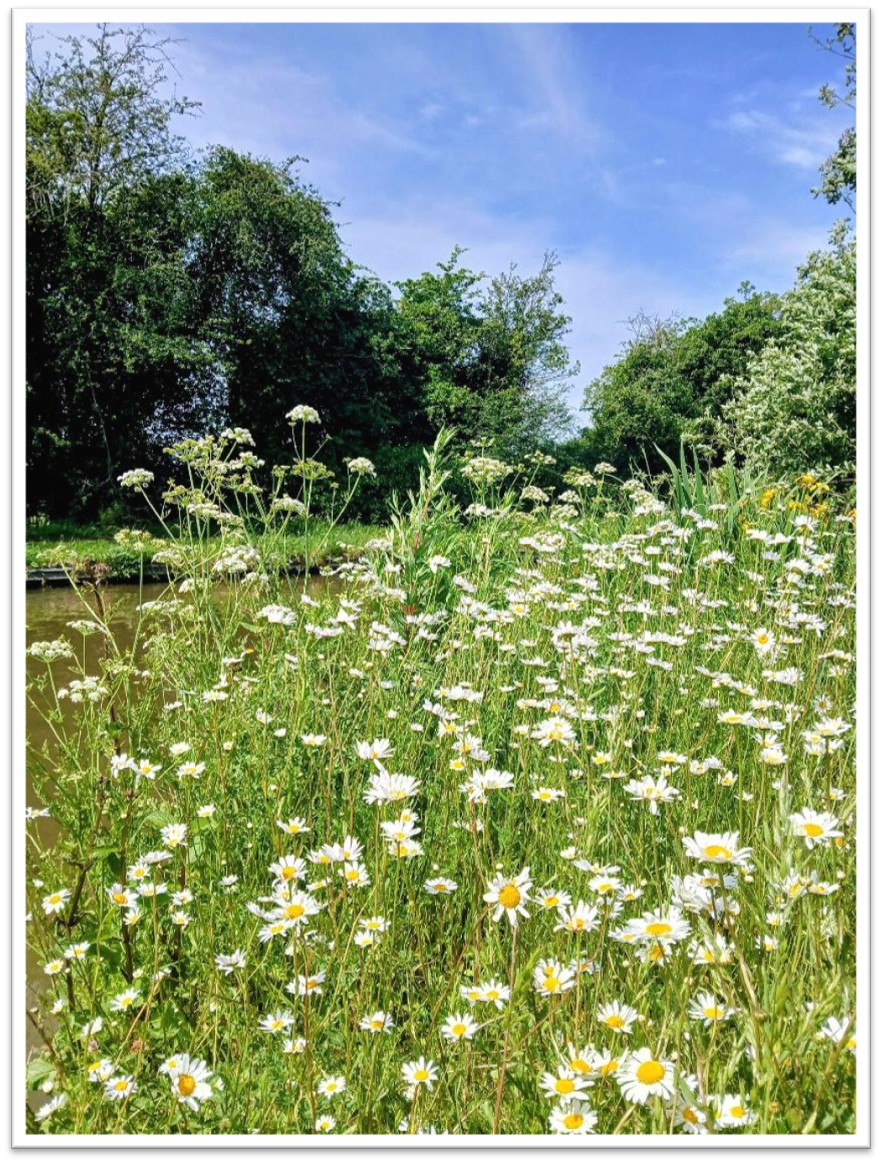 The bank of ox-eye daisies beside the canal (but this time in the sunlight!)
In this episode I reflect on Jeff Van Booven’s reflections following the previous episode on time.
With special thanks to our lock-wheelersfor supporting this podcast.
Ana McKellar
Susan Baker
Mind Shambles
Clare Hollingsworth
Kevin B.
Fleur and David Mcloughlin
Lois Raphael
Tania Yorgey
Andrea Hansen
Chris Hinds
Chris and Alan on NB Land of Green Ginger
Captain Arlo
Rebecca Russell
Allison on the narrowboat Mukka
Derek and Pauline Watts
Anna V.
Orange Cookie
Mary Keane.
Tony Rutherford.
Arabella Holzapfel.
Rory with MJ and Kayla.
Narrowboat Precious Jet.
Linda Reynolds Burkins.
Richard Noble.
Carol Ferguson.
Tracie Thomas
Mark and Tricia Stowe
Madeleine Smith
General Details
The intro and the outro music is ‘Crying Cello’ by Oleksii_Kalyna (2024) licensed for free-use by Pixabay (189988).
Narrowboat engine recorded by 'James2nd' on the River Weaver, Cheshire. Uploaded to Freesound.org on 23rd June 2018. Creative Commons Licence.
Piano and keyboard interludes composed and performed by Helen Ingram.
All other audio recorded on site.
Become a 'Lock-Wheeler'
Would you like to support this podcast by becoming a 'lock-wheeler' for Nighttime on Still Waters? Find out more: 'Lock-wheeling' for Nighttime on Still Waters.
Contact
- Facebook at https://www.facebook.com/noswpod
- Instagram: https://www.instagram.com/nighttimeonstillwaters/
- Bluesky: https://bsky.app/profile/noswpod.bsky.social
- Mastodon: https://mastodon.world/@nosw
I would love to hear from you. You can email me at nighttimeonstillwaters@gmail.com or drop me a line by going to the nowspod website and using either the contact form or, if you prefer, record your message by clicking on the microphone icon.
For more information about Nighttime on Still Waters
You can find more information and photographs about the podcasts and life aboard the Erica on our website at noswpod.com.
00:00 - Introduction
00:27 - Journal entry
01:02 - Welcome to the NB Erica
02:20 - News from the moorings
06:43 - Cabin chat
13:02 - Moonlight on Ox-Eye Daisies
36:14 - Signing off
36:31 - Weather log
JOURNAL ENTRY
23rd May, Sunday
“Voices lift across the water
No words, just sound
A copy of Baisao in my hand
Lingering over phrases and lines
In the soft evening sun.
I too have my cup of tea beside me
Pine wind among the reeds
Carp twist in crystal light
Swallows dip low to drink.”
[MUSIC]
WELCOME
It's the night of a blue moon, the second full moon to fall in a month. It's the end of a busy warm day of blue skies and sunshine and elderflower-scented warmth. But now the crowds have gone home and the canal and towpath settle back into a contented stillness. A light breeze plays ruffles water and reed stirring the little pockets of the day's heat. The Erica gently creaks at her moorings. An owl hoots in the distance.
This is the narrowboat Erica narrowcasting into the welcoming darkness of a warm May night to you wherever you are.
Greetings, you've made it. I was hoping you'd be here. The kettle is already on, the biscuit barrel is on the side, there's a chair waiting especially for you, so come inside and welcome aboard.
[MUSIC]
NEWS FROM THE MOORINGS
Summer came early bringing with it temperatures of 32° (90°F), locally. We’ve had much hotter, just not at this time of the year, which is concerning. Unusually, it coincided with a bank holiday (the old Whitsun Bank Holiday) and so it came with the air of occasion and relaxation. Someone brought a paddling pool out, but only Maggie would go in, and even then, with a gingerly reserve. It’s strange as a number of the local dogs love to swim in the canal and river (Maggie included). The smell of barbecue and suntan lotion lazily curls over the baking ground. The tall grasses feel good. We search for shade, sprawling beneath trees, on cushions of rye and chickweed, starred pink with cranesbill, and watching the scarlet poppy-fire and the Tibetan flag masts of vetch nod and dance on our skyline.
A hard white sun, shimmering off the water like arc-welder’s glare dazzles and blinds, sending reflected heat right back into the boat. Curtains remain closed. The temperature rises. The problem is that along with the sunshine there is, unusually, hardly a breath of wind. Ventilation has to come from fans and air coolers. I take Mags for a swim.
Frogs croak among the reeds and irises. Carp, in the midst of their spawning, bask just under water. Their dorsal fins piercing the surface like soporific sharks. Fortunately, there’s a lot of movement on the canal – its half-term – and so the water remains aerated. This time last year, when this part of the canal was closed because of a breach, I’d be getting a bit worried for them by now.
Processions of ducklings buzz and fizz behind mum who keeping a wary eye out for magpie and kite. Demoiselle and damselflies dart prehistoric along the water’s edge. Vibrant colours flash and spark; blue, red, orange. It would feel like high to late summer if everything wasn’t still so lush and green. Even the trees are only just losing the light lime and emeralds of their first growth before they deepen into the deep forest greens of summer. Spiral galaxies of elderflower perfume the towpath with the scent of vacation and excitement. I can almost taste the sugar and lemony bite of citric acid. The ox-eye daisies are growing rich and deep along the steep bank beside the canal. Maggie and I wade waist and knee deep through them. A flurry of disturbed insects jewel the air. Butterflies lift and flutter. A moorhen breaks cover to scurry to the opposite bank.
The heron lurks in places green and shady.
[MUSIC]
CABIN CHAT
[MUSIC]
MOONLIGHT ON OX-EYE DAISIES
As I intimated just now, I received a really lovely email from one of our long-time listeners from across the Atlantic, Jeff van Booven. It was in response to the last episode (More Raven than Rook) about my time winding the village clock. Jeff, I hope you don’t mind if I read it out as you make some really interesting points.
“Maybe it’s because we just had a power outage and I had to reset the only three clocks in the house that weren’t automatic, compared to my childhood and going room to room with a watch, but I found myself drifting into thought about the difficulties of ensuring the accuracy of that precious resource, especially as you describe adjusting the hands and pieces to ensure time flows properly.
With radio and television, getting the accurate time of the realm doesn’t seem like much of a challenge. For ages past, from my sparse reading on the subject, seems to be they just relied on local time and nobody much tried to organize a national time until the technology allowed or was desired for sailing. However, I find myself a bit disappointed in this answer. It seems to lack romance and human endeavor. I would rather imagine the king sending forth riders with timepieces to the cities and towns of the realm, literal time travelers if you will, to proclaim the official time. The human element, like the names carved into the cupboard, seems to make it more mythical and magical, at least to my sentiments. The people create a connection between time, place, and generations that our mechanization erases or brings to an end.
Time, it seems, has gone from a local process of measuring the seasons to a rigid, highly accurate, passive background process delivered to us by the machine. Lost is the transitory period where we were invited to be active participants in the process of keeping time. Thank you for your recollections of the waning moments of that period and for your podcast, which is always such a wonderful invitation to set aside the now and spare some time to relax.”
There’s so much here, Jeff, thank you.
I think you are so right, our relationship with time and the concept of time is remarkable and fascinating. Even our understanding of time as this linear path that goes from a beginning to an end is strange. I’ve been recently reading the philosopher Tyson Yunkaporta’s book Sand Talk. Hi Tania (Tania Yorgey), I know you’ve been reading it too. Tyson is also part of the aboriginal nation in Australia and his book is a fascinating and mind-expanding synthesis of various contemporary philosophical and social themes with aboriginal thinking and perspectives. It is taking me some time to read it, not because he writes badly or densely – far from it – but because there is so much to think through and process. I have got stuck on his discussion on time and contrasting the western linear view (a concept so obvious and self-evident to someone brought up in the West) with the aboriginal view of it being circular (a concept so obvious and self-evident to someone brought up within many of the indigenous groups and nations). For example, within his particular culture the vocabulary of kinship reflects cyclical perspectives. Consequently, the kinship system resets every third generation in an eternal cycle. Therefore, you have child, parent, and grandparent. Conceptually, there is no great grandparent, instead the grandparent’s parent is once more classified as child in an endless cycle. His exploration of it has turned my head inside out – it’s the literary equivalent of sucking on a Haribo sour sweet! Conceptually, I am still struggling a bit with it – but I also have to say that now understanding it a little better a lot of the ancient (and Eastern) stuff I have been reading makes a lot more sense. Things fit together more smoothly.
I am also reminded of the irony that for a long time we measured time on a circular clock face despite our assumption of a linear understanding of time – which is essentially teleological – which means the belief that there is some kind of endpoint that things work towards. It’s a system of belief that is grounded in classical Greek philosophy (or at least, some of it) and also in some religions. Culturally we are so embedded in thinking this way that for us it is so self-evident it seems ludicrous to question it. The whole idea of progress (whether that is expressed in evolutionary terms, or social terms, or economic terms, this idea that we are on some journey towards a goal (often an ideal or sense of perfection) suffuses our thinking. We sometimes talk about the march of history as if there were a defined route and direction of travel. This creates the idea that time functions as a pathway that will lead from a Point A to a Point B. When you think about it, it raises a huge number of questions, but we tend not to see past the feeling of time moving past us – or more accurately the feeling of us moving through time. It all feels so normal to us – but it is also a bit weird though, isn’t it, when you think about it?
But getting back to some of Jeff’s observations.
The standardisation of time so that 10 o’clock in the morning in London is exactly the same as 10 o’clock in Birmingham or Newcastle, Swansea or Glasgow is a fascinating story – and one that marks a cultural shift in not just social cohesion but in the choices for what it perceives as its specific teleology – goal or endpoint. The big question here, of course, is, who decided this? The answer might point to many of the causes of our modern-day ills.
Before this – time was much more fluid. Dawn came later or earlier to York than it did in London according to season. It didn’t really matter. The rhythm of life was dictated by the flow of light tied to the seasons; time was a marker of hours and days and shifts in the landscape – time was coloured in greens and browns and whites. Reading Joseph Ashby’s memoirs at the end of the 19th century in a rural Warwickshire village. The same one, I wound the clock in. Clearly the concept of time was familiar to him and those among whom he lived. The church bells rang out the hour and the quarters. But these seemed to function more as auditory markers of the day – fingerposts, if you like, time and daily life was anchored in the land, the crops that needed harvesting, the land that needed to be ploughed. The daily cycle of light and dark signalling daily routine, the cycle of the seasons signalling the deeper and longer shifts in life.
The fact that the bells at St Mary’s rang the 1 o’clock strike fifteen minutes before the great bell in St Stephens Aberdeen was neither here nor there. Time flowed across the land at its own rate according to the landscape and latitude.
We then have two huge shifts that have a cataclysmic effect on how we view time and they both stem from the Industrial Revolution. The first is urbanisation and its development of factories. Now no longer so rooted in the soil and the seasonal ebb and flow of daylight hours we begin to see this disconnection of the population from the land it lives in. It’s a trend we can chart through history (or should I say, histories?). The growth of cities creates cultural shifts in perceptions that become increasingly divorced from the land. The first great cities in Mesopotamia led the way (in the West) in this shift from agriculture and the land. Their calendar and economics reflecting conceptions of time that no longer followed the moon and its effect on land and water, but the sun. We can see this shift a little later in the biblical writings. The Deuteronomic writers introducing a new calendar with new festivals that no longer marked or were in concert with the land, the cycles of crop and livestock.
The great mills and factories of the industrial revolution likewise ran to a different flow of time. One that could be more regulated. Shorter working days in the depth of winter gloom made no sense. Knocker-uppers were employed to ensure the workforce was in place before the sun had risen. Artificial lighting turned night to day. Hours became important, hours measured the working day and when you were not at work, the clock was there to tick away the time before it called you back to work. Time no longer seemed to flow in a fluid motion of ebb and flow but had become rigid. The watchdog of your employer. The creeping darkness of the winter’s lengthening nights now became an irrelevance, just an inconvenience to be conquered in the same way the later canal and railway navvies conquered an obstructing hill or stretch of marshland.
The second major shift was the development of the railways. It has been argued that it was the creation of a national railway system that dictated the need for not just accurate time keeping but a standardisation of it. This was essential for any railway service to operate effectively. Any infrastructure that encompasses a large regional area requires a standardisation of its time. Now it did matter if 1 o’clock in London was 15 minutes earlier than 1 o’clock in Birmingham. Although, of course, I recognise that this in practice means something very different for you, Jeff, over in the States than it does for us in the UK where we all share a single time-zone. However, the principle is the same. The development of the railway system in the UK created some major cultural shifts. For example, the adoption of sans serif lettering – which was a deliberate marketing strategy. However, arguably the greatest impact was that, now the concept of time was not just rigid, but its rigidity was imposed across the nation.
If you are of a similar age to me, you’ll probably remember the pursuit for increasingly more accurate watches and clocks. Advertisements would herald claims about their product being accurate to 100ths of a second. As a lad, I would sit in the dining room listening for the six pips of the Greenwich Time Signal at 6.00pm on the radio. Dad and I would automatically check our watches. My prized Sekonda, a much-cherished birthday present, was invariably a little out and needed to be readjusted. Hands (including the second hand) lined up for exactly 6 o’clock and then at the signal of the last long pip. Once more, my watch was aligned with British time.
Then came the advent of the digital watch. I can still remember mine. A black plastic wrist band on which glowed and pulsed red numbers. We were now talking about quartz crystals and 1000th of a second and milli seconds gave way to nano seconds. We were living in a staggering age where time, so short that we could hardly imagine it let alone experience it was becoming the norm. And not just that, we could wear it first in LED then in LCD on our wrists!
It seemed that the trajectory in which time was going was clear – ever more accurate but also ever more standardised time. Also, it became more visible. It appeared everywhere, flashing at us. On video recorders, then on microwave ovens, and then on even conventional ovens. It’s there in the corners of our laptops and tablets and mobile phones. Everything we do, time is there, following us.
It seems that over time socially or culturally we seem to have got more focused on the smaller and smaller units of time. If you think about it, how many times do we get frustrated over, what are essentially small units of time? The cashier who asks the person in front about a Netflix series they’ve been watching. Having now to drive a half mile section through a village at 20mph instead of 30mph. I am driving down a motorway at 70mph another driver passes me at 80mph. If we kept these speeds for 5 miles, how much time would the other driver have saved? Just 32 seconds. And yet, that need to save time is so compelling. Why does it matter so much to us? Do we feel that we have lost the battle to live our years and days? Have we been robbed of our hours so that the only things we can control are the stray minutes and seconds that we are left with?
Our relationship with time, how we understand it and relate to it has radically changed over the last 200 or so years. A system of time that is based upon the oscillations of a piece of heated isotope, Caesium 133. It flips between two states at exactly nine billion, one hundred ninety-two million, six hundred thirty-one thousand, seven hundred seventy times a second. Rigidity, consistency, and universality. That “rigid, highly accurate, passive background process delivered to us by the machine” that Jeff writes about. It’s a shift that also hides much deeper sets of unquestioned assumptions and unchallenged presuppositions that disclose a lot more about our human experience (and how we understand ourselves and what it is to be human) than simply the development of technology.
It’s all a very far cry from the swing of the sun and moon overhead. But they are still there. The slow circular dance of night and day and the turning of the seasons are still there. And our bodies, somatically, still react and respond to those things. The tides still rise and fall with the moon. The clock on my weather station still pulse, it’s 1980s style LCD numerals that is automatically linked by radio waves to the National Physical Laboratory in Cumbria tells me of the unceasing movement of time. It tells me something, a small piece of informational data. Just outside, I look up at the moon. Hanging weightless, patient, in her arc across the velvet darkness of night. The same moon that is above you, that binds us all in the pale ebb and flow of her light. I have watched her die and be reborn many, many times. I think so have you. Her light is shining down upon the upon the upturned faces of the ox-eye daisies. Unlike daisies they do not close at night. They glow faint and ghostly, transforming the bank beside the canal in luminous soft light. A bank of midnight sunshine. And this is how light and life proceeds, one reflecting the light of the other and so on and so on. And I begin to understand once more what I had forgotten about time.
SIGNING OFF
This is the narrowboat Erica signing off for the night and wishing you a very restful and peaceful night. Good night.


