Listening (under the pterosaurs' sun)
Tonight, we walk through deep time. Ours is a generation who are the witnesses to the Great Unravelling, but we are also part of the Great Remembering. With handfuls of seeds and ancient soil, we walk out of our books, our learning, and our language, to pick up something once lost. Journal entry: 16th October, Friday “Robin song and yellowing leaves Float down upon the silent canal. A moorhen swims into the mist. Jackdaws play around the One Oak,  ...

 Apple Podcasts
 Spotify
 Amazon Music
 Castbox
 Podchaser
 iHeartRadio
 PlayerFM
 Goodpods
 TuneIn
 Podcast Addict
 Castro
 PocketCasts
 RSS Feed
 YouTube
 Tonight, we walk through deep time. Ours is a generation who are the witnesses to the Great Unravelling, but many of us are also becoming part of the Great Remembering. With handfuls of seeds and ancient soil, we walk out of our books, our learning, and even our language, to pick up something once thought lost.
Journal entry:
16th October, Friday
“Robin song and yellowing leaves
Float down upon the silent canal.
A moorhen swims into the mist.
Jackdaws play around the One Oak,
Their voices stabbing the morning light.
A handful of rooks join them.
They settle and watch the pasture below,
And me and Maggie, standing beside still waters
Under a rainbow of robin song.”
Episode Information:
In this episode I read a short extract from John Moriarty’s What the Curlew Said published by Lilliput Press.
I also mention the vlog: Life Aboard Petra.
This episode’s ‘Night View: Through your window’ is provided by good friend of the podcast and lock-wheeler ‘Mind Shambles’.
With special thanks to our lock-wheelersfor supporting this podcast.
Ana McKellar
Susan Baker
Mind Shambles
Clare Hollingsworth
Kevin B.
Fleur and David Mcloughlin
Lois Raphael
Tania Yorgey
Andrea Hansen
Chris Hinds
Chris and Alan on NB Land of Green Ginger
Captain Arlo
Rebecca Russell
Allison on the narrowboat Mukka
Derek and Pauline Watts
Anna V.
Orange Cookie
Mary Keane.
Tony Rutherford.
Arabella Holzapfel.
Rory with MJ and Kayla.
Narrowboat Precious Jet.
Linda Reynolds Burkins.
Richard Noble.
Carol Ferguson.
Tracie Thomas
Mark and Tricia Stowe
Madeleine Smith
General Details
The intro and the outro music is ‘Crying Cello’ by Oleksii_Kalyna (2024) licensed for free-use by Pixabay (189988).
Narrowboat engine recorded by 'James2nd' on the River Weaver, Cheshire. Uploaded to Freesound.org on 23rd June 2018. Creative Commons Licence.
Piano and keyboard interludes composed and performed by Helen Ingram.
All other audio recorded on site.
Become a 'Lock-Wheeler'
Would you like to support this podcast by becoming a 'lock-wheeler' for Nighttime on Still Waters? Find out more: 'Lock-wheeling' for Nighttime on Still Waters.
Contact
- Facebook at https://www.facebook.com/noswpod
- Instagram: https://www.instagram.com/nighttimeonstillwaters/
- Bluesky: https://bsky.app/profile/noswpod.bsky.social
- Mastodon: https://mastodon.world/@nosw
I would love to hear from you. You can email me at nighttimeonstillwaters@gmail.com or drop me a line by going to the nowspod website and using either the contact form or, if you prefer, record your message by clicking on the microphone icon.
For more information about Nighttime on Still Waters
You can find more information and photographs about the podcasts and life aboard the Erica on our website at noswpod.com.
00:00 - Introduction
00:26 - Journal entry
01:10 - Welcome to NB Erica
02:19 - News from the moorings
07:58 - Cabin chat
14:10 - Listening (under the pterosaurs' sun)
31:37 - Extract from John Moriarty's 'What the Curlew Said'
33:16 - Night-view through the window by 'Mind Shambles'
35:38 - Signing off
35:55 - Weather log
JOURNAL ENTRY
16th October, Friday
“Robin song and yellowing leaves
Float down upon the silent canal.
A moorhen swims into the mist.
Jackdaws play around the One Oak,
Their voices stabbing the morning light.
A handful of rooks join them.
They settle and watch the pasture below,
And me and Maggie, standing beside still waters
Under a rainbow of robin song.”
[MUSIC]
WELCOME
There’s been a cool northeasterly blowing all day. It has dropped a little now, but there’s a chill of night in the air. Smoke curls from chimneys and cabin lights seep around drawn curtains and spills like living paint upon the water. Sheep breath turns to steam. A moorhen drops down into the water.
This is the narrowboat Erica narrowcasting into the darkness of an October night to you wherever you are.
How are you? It’s so lovely to see you, I hope you are well. I am really pleased that you could make it tonight. The kettle is already on, so come inside where the cabin is warm and there’s a chair waiting especially for you. Watch your footing on the steps and welcome aboard.
[MUSIC]
NEWS FROM THE MOORINGS
Yesterday, we lit the fire for the first time this autumn. We’ve had a few chillier nights, nothing remarkable, but enough to hint at the need to think about heating again, rather than just using the central heating to take off the morning chill. The timing was perfect as, this morning, we had our first frost of the season. Again, it was nothing spectacular and the temperature kept above zero, but it was cold enough to paint white frosty lines across the long grass beside the towpath, and skim the cabin roof with a feathered rime of ice.
A few short months ago I could never imagine needing a fire ever again, but the cycle of the seasons moves swiftly on and at the time when I was sitting on the stern willing the sun to drop behind the templed ash to give us some shade, I am now looking up into the sky at Orion climb over the horizon and the plough circle slowly overhead. The thought of dangling my feet into the water makes me shiver!
But it is nice to have the warm cherry-red glow of the stove in the corner and there is a sense of the closing of a door. Summer is definitely over. Autumn is definitely here. We have now traversed from time of long days to the time of long nights. As Donna lit the kindling, there was the feeling of a marker being laid. Like our summer wardrobe, it is time to put our summer habits in safe keeping until next year. Jumpers and boots feel bulky and clumpy. Simply slipping outside, barefoot, through doors which remained open all day, is now not appropriate or conducive. Subtle shifts in thinking and attitudes become evident. That outside job can wait until a few more emerge and warrant the hassle of pulling on wellies and jackets. Remembering how much coal to bank up the fire so that it lasts through the night. Remembering to keep the bathroom door open, so it doesn’t feel like you’re entering a fridge every time you want to use the loo. Making sure the ash can is handy, but not so handy that you keep tripping over it.
None of this is bad, it is just that this time of year seems to emphasise how much the seasons have an effect on our living and lifestyle. I suppose the unusually long spell of warmth has also meant that our cooler season routines are a bit rustier than normal.
And so, we now come inside the boat for warmth, and steam rises from the canal in the mornings turning dawn into gothic theatre. Spiders scuttle everywhere, and squirrels race and squabble up tree and down. The ducks forming pairs, rove along the waters in larger groups. The cormorant is back. Circus troops of goldfinches, cluster and carnival among the late blooming flowers, picking at hedgehog-shaped teasel heads, although the few around here have already been picked clean of seeds. The trees, in the main, still hold their green, although the yellowing has begun.
The canal has now been reopened for a couple of weeks. Initially the canal was busy, but once more, apart from the day boats, it has quietened down again. Partly, I think, because of the time of the year, but also the levels are still very low. Returning friends and neighbours, who had been caught out by the stoppage, reported a difficult time of it, with boats catching the bottom and continued low water levels. Local talk is that the CRT will have to close the canal again. No one is really prepared to move much, just in case they do. It’s a bit too early to think of winter moorings, but no one wants to be on the wrong side of a stoppage.
And so, we stay, content under the piling skies of blues and greys of autumnal light and shade with hawking winds, circled by kite and buzzard, and roistered by rooks and jackdaw calls. It’s a good sky to be living under.
[MUSIC]
CABIN CHAT
[MUSIC]
LISTENING (UNDER THE PTERSOSAURS’ SUN)
I am lying on the bed reading and I gradually become aware of the patter of feet on the wooden floor just below me, and then Maggie jumps up to join me. She snuggles up close to where I am lying. I can feel her warmth, and, as she slowly relaxes into shallow sleep, the feather soft snuffle of her breathing. I feel the weight of her head and the warmth of her breath. This is old language being spoken here. A language in which we were once fluent and now have all but lost, save even these golden moments sharp with clarity – emerging through the suffocating veils of our modern dementias and our loss of self. I know and I know that Maggie knows, and what it is we know lies far, far beyond the reach of words. And for a short while, I recognise the enormity of what we have lost. The pottage of lentils for which we convinced ourselves was worth relinquishing our birthright, in this burning world seems very thin gruel to what we once had – although, in truth, it is still ours to pick up once again. Unlike Jacob and Esau, for all the bluster and angry talk, our horse-trading with Isaac is still not yet a done deal.
And so, I lie with the weight of Maggie on my side, not wanting to move lest I disturb her and am sent tumbling back to a world divided; of man and other; of I and it. She has buried her head into my side, in the way that I want to curl into the mothering curve of this earthen bank. To press my head close, in wordless conversation with it. Conversation older than grammar, far, far deeper than syntax. There are times it happens. I am reassured that they occur more now than they ever did in my past, save perhaps within the ghost-realms of my childhood. Times when walking along a familiar stretch of towpath, or looking into the unsilent still waters of the canal, or wandering aimless across the fields that I seem to walk out of a world that can be contained within books and vocabularies and numbers, I walk out of my life-learning and out of the cloistered corridors of my knowledge and into a world unfiltered and unbordered by expectation and education.
To walk this battered and broken Eden with the eyes of the first Adam and the eyes of the first Eve, and to see its batteredness and to feel its brokenness, is a precious and painful thing. Perhaps, that’s why I experience it only rarely. Perhaps, I should not seek it. But like Maggie, curling into me so that the weight of her body is borne on side and hip, it feels essential that I do. There are things to be spoken that need to be spoken and things to be heard that need to be heard – each soul deep and beyond language.
In his book The Lost World of the Kalahari, the south African explorer Laurens van der Post documented his time living among the San people. When one of the San elders asked him, "why can't you hear the stars?" He initially laughed, assuming they were being poetic or joking. However, the elders were entirely serious.
To the San people, the stars are active participants in the universe that sing clearly to anyone with ordinary awareness. When they realized van der Post truly could not hear them, their laughter turned to profound sorrow and pity. They did not view his inability as a simple sensory deficit; rather, they interpreted it as a "grave sickness of the soul" or a state of being spiritually dead, cut off entirely from the rhythm and reality of the universe.
I recount that, as it is an account that has recently been doing the rounds on one of the social media platforms. As expected, it has drawn a long and heated trail of comments, mainly regarding colonialism and ad hominem dismissals. Those that relate to the idea of stars talking reassert that the San couldn’t possibly mean this literally and to argue that they did is a form of racism and denial of their sophisticated knowledge and understanding of the stars and astronomy, despite this claim being recorded within indigenous oral and written traditions right across the globe.
And then there are times… not always, not even mostly, but there are times, standing under the great bowl of the night sky glittering with stars, and the night breeze among trees, and a skim of cloud, when I am not so sure of all these claims made by keyboard warriors, locked into their worlds of one-dimensional literalism and their cast-iron certainties. As we are beginning to realise, in our growing, we are becoming deafer, losing the sensory abilities that once kept us alive and flourishing. After all, when standing under a tree, when a bird sings, his song is as much as for you as for anyone else.
We are living at a time experiencing the catastrophe and heartbreak of monumental environmental collapse. For, to paraphrase the words of Lin Yutang and Walter Savage Landor, we are living in a time when small men cast very long shadows across of world because our sun is low and about to set. Ours is a generation who are the witnesses of the great unravelling. But – and this is the most important and hopeful of BUTs, we are also part of the great remembering. A remembering of not so much what was, but of old knowledge, once-forgotten skills, older wisdoms and ways of thought.
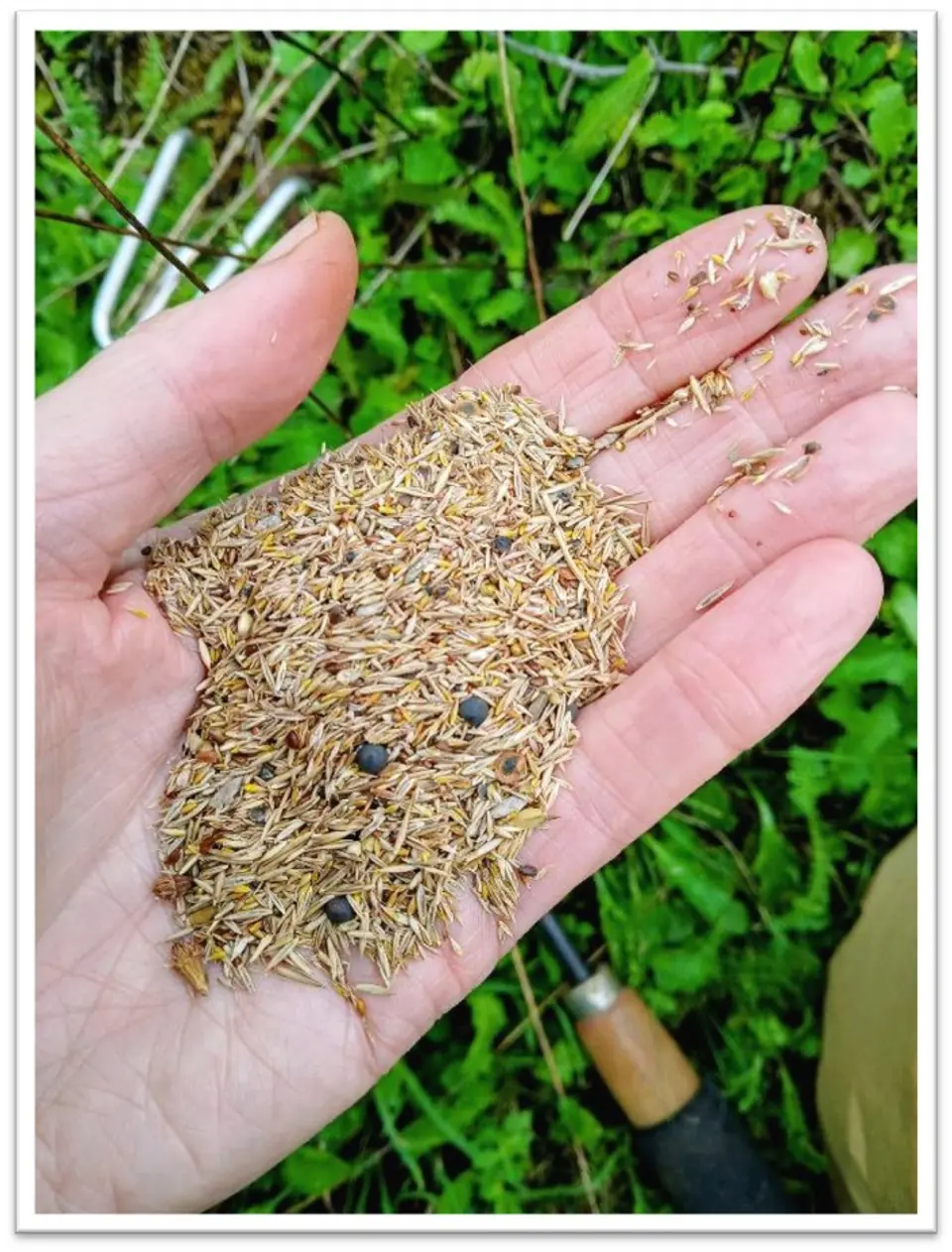
Maybe that is why, in the last folding weeks of September, I was standing beside this steep crest of hill holding in my cupped hand the warm dry weight of wild flower and grass seeds. All spring and early summer I kept visiting this stretch. It became my Eden, grounding me with its imperfect beauty. Lush in part, threadbare in others. Patches of the slope are so steep that the marly soil crumbles and falls away, exposing the underlying bedrock of Blue Lias mudstone. Even the faster growing of the grasses have a difficult time taking root. Only the ox-eye daisies seem to some sort of hold. In early summer, as the grip of drought was just beginning, I counted 39 different species of plants in this small stretch – and that was not counting the grasses. Flowers burst into colourful profusion, changing almost daily. The air thrummed with insects. Waves of butterflies flew knee high with each step. Damselflies sparked and flashed. In a world which seemed to be draining of life, this was a world in which life seemed to flourish, even when the heat took hold and the earth cracked and broke open in jagged wounds.
That long summer, I would sit at top the hill, among the waving long grass, watching the water sparkle below me, and the little nest of boats, and the shadowy forms of carp just below the surface in the shallows, languid and dozing, until the heat became too intense and drove me under the ash tree. Maggie chewing on fallen twigs and branches, or rolling on her side in the grass. It was space that I needed, a chance to breathe in the claustrophobia of the world, the unravelling of plans, and the uncertainty of the future. It was also a chance to re-remember that there are few things more important than just listening – and that there are languages beyond words, beyond sound.
I am not talking here about some metaphorical anthropomorphisation of the world. This has absolutely nothing to do with whimsy or an escape into sentimentality and delusions. This type of listening strips you of all notions of exceptionalism and ego. There is little comfort or reassurance to be had it in its doing. In fact, it can, at times, be brutal and it can wound. The truth, no matter how softly it is sung and no matter how much healing it can bring, cuts deeply and stings. You don’t walk upon the earth in the same way afterwards. You walk with a little more humility in your step, a little more softly; not as one who knows, but as one who has just begun to learn. It can be uncomfortable and disorienting; devastating even – it was not for nothing that practices like this were viewed as sacred acts. Maybe that is why we trained ourselves out of it in the first place. Who alive is brave enough to stand under the bowl of the night sky and listen for the stars to sing or to stand in the barren neglected scrap of land and just listen?
And now was the time to give back something. Not in the transactional sense, but in the relational one. Not from a sense of obligation or beneficence, but simple from the joy of being part of something greater than us both. We bought a big bag of wild flower seeds and then someone else denoted another, even bigger, bag of seeds. And so, in the evening of summer, on a couple of days of soft drizzle and playful winds, I became a sower of seeds. I became the mother plant with seeds to sow. Feeling them slip between my fingers, casting them into the wind to fall wherever the wet-wind decided. I became, for a while, the wind and bird that carried them to their earthy sanctuary and home. I was the north wind and the south wind, the east wind and the west.
Who knows how many will root and grow? That is not my weight to carry. Each seed knows exactly what to do and all I could do was to give the best chance to do it. Now it is their turn. Taking hold of soil laid down in late Triassic and early Jurassic times. Deep history that lives on in plants and even us. The warm tropical waters of ichthyosaurs and plesiosaurs. Now exposed to the sun and rain once more and seeded with life. And as my hand brushes the friable bedrock, I am touching deep time. A world that rang with grunt and bellow that no human ever heard. An ancient world whose sun shines still shines on me, the same feeling of rain gusting on westerly winds wets that world and ours. Next time you’re out, look up at the sun. That sun is the dinosaurs’ sun. It was under its eye that the pterosaurs' spread great wings and flew; it has watched upheaval and flourishing. The swarms and the dying of life on this planet. Five of them, and now the sixth. The dry little husky seeds fall and fly from my hand, nestling into the broken soil, the crumble of earthy-rock, fissured and cracked, seeding the ancient soil that spawned ferns and conifers and knew the weighty tread of dinosaur feet. And the Triassic sun is here to nurture each seed, and once grown, will feed each plant with its light. No wonder the daisies and the dandelions open their flower each morning to the rise of the sun!
And so, this too was a time when I was walking and living beyond the reach of my books or the internet, beyond knowledge and my learning. A time when I felt that I was not the one listening, but the one who was being listened to… and understood. An experience like that shifts the centre of your gravity. Your feet find a different way of walking in those places where that occurs.
It took me back to a passage from one of the most important books I have ever read, John Moriarty’s What the Curlew Said.
[READING]
[MUSIC]
NIGHT VIEWS (THROUGH YOUR WINDOW)
With thanks to ‘Mind Shambles’ (Suffolk, UK).
[MUSIC]
SIGNING OFF
This is the narrowboat Erica signing off for the night and wishing you a very restful and peaceful night. Good night.


