An Under-Sung Companion (to the canal)
Join us tonight as we reflect on that often under-appreciated companion to the canals, the humble towpath. We uncover its vital importance in the past and how in, recent years, its relationship with the canal has been changing. We also meet up again with E Temple Thurston and the good captain Eynsham Harry as the meet a figure of the forgotten past. Journal entry: 5th March, Thursday “A warm sun that hums With the buzz of big bodied Bumblebees busy among Th...


Join us tonight as we reflect on that often under-appreciated companion to the canals, the humble towpath. We uncover its vital importance in the past and how in, recent years, its relationship with the canal has been changing. We also meet up again with E Temple Thurston and the good captain Eynsham Harry as the meet a figure of the forgotten past.
Journal entry:
5th March, Thursday
“A warm sun that hums
With the buzz of big bodied
Bumblebees busy among
The soft fall of plum blossom.
A gust of wind swirls
The petals like stirred tea.
The call and response
Between mother and lamb.”
Episode Information:
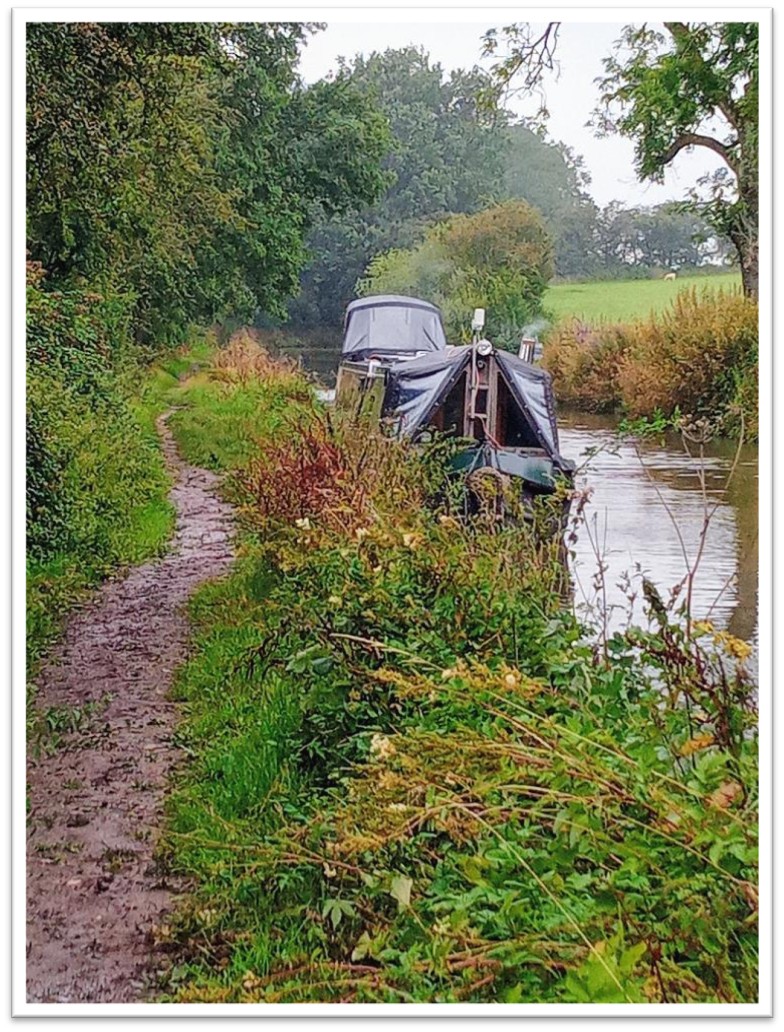
The towpath meandering beside the Erica one wet autumn afternoon
In this episode I refer to Alice McGladdery’s (2016) Canal Boat Ancestors: A beginner’s research guide, information given by The Rothen Group, the Jerico Wharf Trust, and the CRT’s 2026 report Vital Connector for People and Nature. I also read a short extract from E Temple Thurston’s (1910) The Flower of Gloster.
For more information about E Temple Thurston's time on The Flower of Gloster, you might like to listen to an earlier episode which is part of our 'Summer readings' episodes: Temple Thurston's 'The Flower of Gloster' (Summer readings #2).
With special thanks to our lock-wheelersfor supporting this podcast.
Ana McKellar
Susan Baker
Mind Shambles
Clare Hollingsworth
Kevin B.
Fleur and David Mcloughlin
Lois Raphael
Tania Yorgey
Andrea Hansen
Chris Hinds
Chris and Alan on NB Land of Green Ginger
Captain Arlo
Rebecca Russell
Allison on the narrowboat Mukka
Derek and Pauline Watts
Anna V.
Orange Cookie
Mary Keane.
Tony Rutherford.
Arabella Holzapfel.
Rory with MJ and Kayla.
Narrowboat Precious Jet.
Linda Reynolds Burkins.
Richard Noble.
Carol Ferguson.
Tracie Thomas
Mark and Tricia Stowe
Madeleine Smith
General Details
The intro and the outro music is ‘Crying Cello’ by Oleksii_Kalyna (2024) licensed for free-use by Pixabay (189988).
Narrowboat engine recorded by 'James2nd' on the River Weaver, Cheshire. Uploaded to Freesound.org on 23rd June 2018. Creative Commons Licence.
Piano and keyboard interludes composed and performed by Helen Ingram.
All other audio re
Become a 'Lock-Wheeler'
Would you like to support this podcast by becoming a 'lock-wheeler' for Nighttime on Still Waters? Find out more: 'Lock-wheeling' for Nighttime on Still Waters.
Contact
- Facebook at https://www.facebook.com/noswpod
- Instagram: https://www.instagram.com/nighttimeonstillwaters/
- Bluesky: https://bsky.app/profile/noswpod.bsky.social
- Mastodon: https://mastodon.world/@nosw
I would love to hear from you. You can email me at nighttimeonstillwaters@gmail.com or drop me a line by going to the nowspod website and using either the contact form or, if you prefer, record your message by clicking on the microphone icon.
For more information about Nighttime on Still Waters
You can find more information and photographs about the podcasts and life aboard the Erica on our website at noswpod.com.
00:00 - Introduction
00:33 - Journal entry
00:53 - Welcome to NB Erica
02:00 - News from the moorings
05:11 - Cabin Chat
10:18 - An Under-Sung Companion to the Canal
33:01 - Excerpt from E Temple Thurston's 'The Flower of Gloster'
37:41 - Signing off
37:56 - Weather log
JOURNAL ENTRY
5th March, Thursday
“A warm sun that hums
With the buzz of big bodied
Bumblebees busy among
The soft fall of plum blossom.
A gust of wind swirls
The petals like stirred tea.
The call and response
Between mother and lamb.”
[MUSIC]
WELCOME
All is still along the canal-side tonight. Hardly a breath of wind stirs. The canal is silent, sleeping gently, as a waning moon dips below the horizon. Tread quietly, let's not wake the slumbering world.
This is the narrowboat Erica narrowcasting into the darkness of a night in early spring to you wherever you are.
I am so glad that you could make it tonight. I've already put the kettle on in the hope you'd come. It's not cold, but there is a damp night-time chill, so step aboard and come into the warm. The kettle is whistling on the stove; the biscuit barrel is full and there is a seat waiting especially for you. So come inside and welcome aboard.
[MUSIC]
NEWS FROM THE MOORINGS
Things happen. Stuff happens. Unexpected, unplanned. So, I am feeling a mite bit under prepared tonight, or more so than usual. But that is the very nature of life. The wind ravages the nest, buzzards raid the clutch of eggs, and the next day, we serenade the dawn with the songs of our lives. Ducks flex, moorhens scuttle, on the top most branch of the oak, a rook watches the world with a guarded eye. A world that is slowly, ever so slowly, changing colour.
First come the blaze of yellows of celandine, coltsfoot, dandelion, wild daffodil, cowslip; the pilot lights of spring. “Shut the fridge door carefully,” Mum used to say, “or you’ll blow out the pilot light.” And so, I tread carefully passed these flickering flames in case I should, by accident, snuff them out. Although, I need not worry, not even the fiercest blast of winter can extinguish Spring’s vernal fire. And now, the whites are too appearing, bittercress, daisy, and along the towpath, tiny, tight, polystyrene balls of blackthorn blossom buds turning slowly white. The plum and damson trees, shower the ground with white petalled snow.
Under the oaks and hawthorn, the bladed leaves of Lords and Ladies (or cuckoopint) are in rich profusion. I’ve never seen quite so many along here before. They are everywhere you look, like the slick, thick tongues of great green dogs. There is something regally mythical about them.
The weather, at long last, appears to have settled into a more drier cycle of late. In fact, a few very warm, calm days of blue skies, that brought a bustle of bumble bees to the plum blossom, gave us our first proper taste of spring, and the chance for the fields to dry out a little. It was nice to feel the warmth of sunshine on my back again. Yesterday, the wind turned ushering in cooler, damp, air that is not cold, but has a rawness to it, that makes you glad to get inside beside the stove again. Each morning and each evening gets perceptively lighter. The flood tide is gathering pace.
[MUSIC]
CABIN CHAT
[MUSIC]
AN UNDER-SUNG COMPANION (TO THE CANAL)
A narrow path that threads its way through town and country, city and farmland. Often no more than a strip of trodden soil that somehow finds a balance between meandering and straight. Hedged by tall plumes of grasses, reeds, brambles, the tracery of ivy and the hum of bees. A path of many moods and many persuasions, as quixotically liable to change to defy description. Lush, desolate, dusty, a muddy quagmire, paved, wild and overgrown, popular and crowded, lonely and ignored. Shadowed by willows and bull rush, shaded by rusty derelict spoils of dead industry, coloured with deep verges of wildflowers, painted vibrant on graffitied concrete. Who knows what the next corner will bring or where they will bring you? That’s the magic of towpaths. Like this one.
Here:
A grey and windy February morning in a gloomy cutting overshadowed by an oak and on the other bank an elm. Their branches intermingle so that squirrels can cross the canal without jumping. Towpath-side, hazels and blackthorn scramble upward for light. It’s an earlyish Saturday morning, although too late for the dawn chorus. A small group of ducks, peck and forage among last year’s leaves, and this year’s bugs. A light rain tries to fall. The towpath is deeply furrowed and pitted where the winter muds lay thick and slimy rendering this stretch well-nigh impossible to navigate. Enough mud remains, to remind you of the turning seasons. And if you point your toes that way, you can carry on walking for nigh on 2,000 miles. Criss crossing much of England and even into Wales without ever leaving it.
Fancy getting away from it all, finding small spaces largely unvisited, where the sound of wind-song in the poplars and the rasp of raven are the only voices you will hear? The towpath will take you there. Fancy the pulse and throb of big city nightlife? Keep walking, the towpath will take you there too. Or it will tumble you back through time, taking you to places where the sounds and smells of Victorian industrial power – red bricked and coal-thirsty – can still be experienced. Or to a park-like promenade, crocodiled with pushchairs and children on bicycles, and ice-cream eating young families, who stand and watch a pair of swans proudly parade their young to the sound of ‘aaaahs’ and then try to peer through the window of a moored boat and take a selfie beside its bow. Oh yes, keep walking the towpath will take you to all these places and more. Oh, so much more.
This under-sung companion to the canal. This narrow strip of land the follows the course of the canal, nimbly leap frogging from one side to the other on sweeping curves of porpoise-backed bridges. Slightly diminutive to the lead and green dark waters. There’s a feeling that it knows it’s the ‘plus one’ to a fancy soiree. Happy for the waters to take the lead, to chart the way. Trotting happily (for the most part) beside its big brother – and would that be sister? Without the canal it would not be here. Its whole existence is predicated on this trench of water, cut into the fabric of our rural and urban landscapes. Although, is that relationship at last changing? Certainly, in a lot of places the towpath has taken the lead. Nicely metaled and maintained – even decorated with colourful information boards and signposts, it lends its revitalised arm to its elderly sibling, now unnavigable, choked with silt and vegetation, in a few places, devoid even of water. Arguably, the focus of the main organisation who maintains much of the British inland waterways suggests that the increasing use of towpaths by the general public as places of recreation, education, and conservation provides the stronger argument for the preservation of canals. To boaters it can feel all wrong. It’s not the way of things or how they should be done. We are used to thinking about the canal largely in terms of water, its depth, its freedom from obstruction and hinderances. The towpath only becomes part of our world when we stop. The towpath is after all, just the canal’s ancillary; its adjunct. The canal will remain the canal without it. But what is a towpath without a canal? But then again, there is sense to it. This shifting of balance in the relationship. There’s a part of me that welcomes the fact that the towpaths are gaining greater recognition for what they do and for what they bring. Perhaps, the towpaths are at long last coming of age.
I was prompted into thinking again about the towpath this week. It was a comment that Charlie Alice Raya (hello Charlie) made on a post on Bluesky where she noted that having come across a number of boaters who write on Blue Sky she “finally looked up what a towpath was.” Charlie made such an important point. It is so easy to forget that common terms in one world might be totally unfamiliar in another. From listening statistics, roughly a little over a half the listenership of this podcast live overseas. And so, I am sure that Charlie was not on her own in not knowing quite what a towpath was (or is).
So, let me explain it all a little bit more.
In very simple terms, a towpath is the path that lies alongside a canal and some parts of, but by no means all, rivers. Originally, they were called Towing Paths and this term is still used by the Ordnance Survey on their maps. However, they are more commonly referred to as the Towpath.
When the canals of the canal era were first dug in the mid 1700s, it was recognised that the traditional forms of boat propulsion, sails and oars, would not be appropriate. Canals were therefore built with a path running alongside them to accommodate a horse, donkey, or mule, to pull (or tow) them. There was never any nationwide standard width to them, each canal company building according to the assumed need, resources, and (importantly) costs. This means, towpaths (specifically their width) can vary on different canals. The Jericho Wharf Trust hold documents relating to the construction of the Oxford Canal records a 7‑ft (2.1 m) towpath alongside a 16‑ft (4.9 m) canal bed. Whilst this is certainly not the national norm, it might give you an idea of the size. I would say, it pretty much reflects the average ratio of towpath to canal bed here, locally, too. The Canal and River Trust state that, “typical working widths ranged from roughly 1.8 m to 3.6 m (about 6–12 ft), depending on location and usage.”
The key thing was to provide clear and safe passage for the animals used for towing and their handlers. Towing or towpaths were therefore an essential and intrinsic part of the canal system. Successful navigation and conveyance of cargoes depended as much on well-maintained towpaths as it did on the water and lock systems.
To this end, each canal company employed specific workers to ensure that the towpath was clear and properly maintained. These were the ‘lengthsmen’. Alice McGladdery notes that lengthsmen lived in cottages alongside the canal or were given the use of a hut to work from that were located on the stretch of canal that was allocated to them. They were responsible for cutting back vegetation, removing overhanging branches and cutting back overgrown bushes. Presumably they also dealt with erosion and subsidence should it occur. Mud, as a lot of boaters will appreciate this year, is a perennial problem during wet periods, and slippery mud banks not only made towing difficult (and slow), it could also be dangerous. Having seen this last month or two, locally, the amount of mud churn caused by groups of walkers and cyclists (and how slippery and difficult to walk it became), I can only imagine what the state of a path might be like that received a high level of horse-drawn traffic. The mud, combined with horse droppings must have made stretches absolutely treacherous. We have a number of accounts of horses slipping into the canal, sometimes taking their handler with them. One account detailing that the person working the horse was crushed beneath them. Tragically there are a number of accounts of horses and handlers (who were often children) slipping into locks and drowning. The lengthsmen’s job was therefore crucial to the efficient and safe running of the canal. McGladdery also observes that they also looked after lock paddles and kept the mechanism greased.
Gladdery seems to show that this role was distinct (certainly at an early stage) from that of the lock keeper. However, the lengthsmen’s responsibility came to come more and more under the remit of the lock-keeper. Certainly, the lock keepers that I was aware of in the 60s seemed to be involved with towpath maintenance. Moreover, later accounts written by lock keepers also show that this responsibility seems to have been passed on to them. I cannot, as yet, find when the role of the lengthsman became obsolete. Having said that, following the adoption of motorised forms of propulsion, the need for long stretches of clear towpath was not so important. From memory, towpaths were generally maintained around locks, to allow working crews to safely get on and off their boats to operate the locks, and where the path ran close to villages and towns and had become an established pedestrian route either for leisure or as a footpath to certain destinations. In the late 70s I often used the towpath as my preferred means to walk from Kings Langley running through Nash Mills and Apsley to Hemel Hempstead and back. It felt much more direct. I sometimes used the towpath in the opposite direction to get to Watford. However, I was also aware that there were stretches beyond Berkhamsted and Tring where the towpath had disappeared completely. In my early teens I semi-seriously planned on riding my bicycle all the way along the Grand Union to Chick, my grandmother, in Long Itchington. I calculated that it would take me around two days. It never really progressed beyond day dreams, the main obstacle that I could foresee was the poor quality of the towpath, due to erosion, subsidence, and overgrowth, in the less-frequented rural sections.
It is easy to think that, given the popularity of towpaths, among the general public, for recreation and leisure pursuits today that this has always been the case. As I mentioned earlier, like most others, I treated towpaths as I would any other footpath, offering a quick (often short-cut) route to a particular destination. However, originally, historically, they were private industrial routes owned by canal companies for horse-drawn traffic, often requiring permits for access. I remember Dad telling me of a time, when he was a boy, going for a walk with his uncle along a towpath. I am guessing that this was around the mid-1930s, and I think that probably it would have been the Grand Union Canal, as Dad was, at that time, living in Wembley. He went on to recount how one of the crew of a passing working boat hurled abuse at them, and saying in no uncertain terms, that they had absolutely no right to be there. Something, which Dad admitted they were very aware of. Walking along the towpath, he said, was viewed in the same light as walking along a railway track today. Rolt writes that each evening at Banbury the towing path was effectively shut by drawing across it and locking metal gates. Even after nationalisation towpaths were still not public rights of way. The Rothen Group, an organisation involved with canal and towpath maintenance, state that towpaths really only transitioned in to public permissive rights of way to walkers and cyclists in the late 1950s and early 1960s, with British Waterways (established in 1962) removing the requirement for permit access for walkers. Cyclists were required to purchase permits to use the towpaths up until 2012.
And now, this under-sung companion to the canal, is perhaps receiving some of the acknowledgement of its importance that it really deserves. This long green linear corridor that reaches into the heart of the cities is becoming once more important. As the Canal and River Trust’s recent report. ‘Vital Connector for Nature and People’ states: “The trust’s 2,000-mile network of waterways, banks, towpaths and hedgerows forms a continuous ecological system running through cities, towns and countryside, reconnecting habitats that would otherwise remain fragmented. As linear corridors, canals allow species to move across urban and rural landscapes, a role that is particularly important in post-industrial and intensively farmed regions of central England where natural habitats have been heavily reduced.”
This 2,000 mile green corridor now links 68 SSIs (Sites of Scientific Interest), 3,000 county wildlife sites and include around 750 miles of canal granted Green Flag status.
This towpath, here on this gloomy break of day on windy February morning, will take you there, and more. It always has, and as long as it lasts, and is maintained, it always will.
And as we walk, if indeed, we do decide to walk and leave this place, along this winding straight thread of earth and stone, who knows where this path will lead? One thing we do know, the canal needs the path as much as the path needs the canal. Two travellers, different in nature, happily sharing the journey together. And as we walk, we do it in the steps of all those forgotten people who have worked to keep this path viable. People like old Willum, lengthsman on the Thames and Severn Canal near Sapperton, captured with such melancholic brilliance by E Temple Thurston in his book The Flower of Gloster. Written in 1910, it is a description of Temple Thurston’s voyage along the canals and waterways starting at Oxford and threading his way down to Gloucester on the working boat The Flower of Gloster with the able and watchful service of Eynsham Harry (the boatman) and Fanny the horse. Temple Thurston was aware that canals and the working boater were part of a disappearing world, left behind by the modernity of steam. His book is a eulogy to this passing way of life. It is perhaps deliberate that Temple Thurston chooses to end his book (and record of his travels) with this poignant pen portrait of an old-world man facing the future of the new world that was dawning.
[READING]
SIGNING OFF
This is the narrowboat Erica signing off for the night and wishing you a very restful and peaceful night. Good night.