Canal Life (Now and Future)
The failure of the Whitchurch embankment offered sobering viewing for those on and off the canal. This episode responds to listeners’ concerns and questions and then reflects on the wider implication of incidents like these on the future of life on the canals.
*Spoiler -it is not all doom and gloom!*
Journal entry: 6th January, Tuesday “Colder night But slightly milder dawn A few desultory snowflakes fall Flightless feathers With no wind Upon which to dance Will these small fla...






The failure of the Whitchurch embankment offered sobering viewing for those both on and off the canal. This episode responds to listeners’ concerns and questions and then reflects on the wider implication of incidents like these on the future of life on the canals. *Spoiler - it is not all doom and gloom!*
Journal entry:
6th January, Tuesday
“Colder night
But slightly milder dawn
A few desultory snowflakes fall
Flightless feathers
With no wind
Upon which to dance
Will these small flakes
Ever get the chance
To find the sea?”
Episode Information:
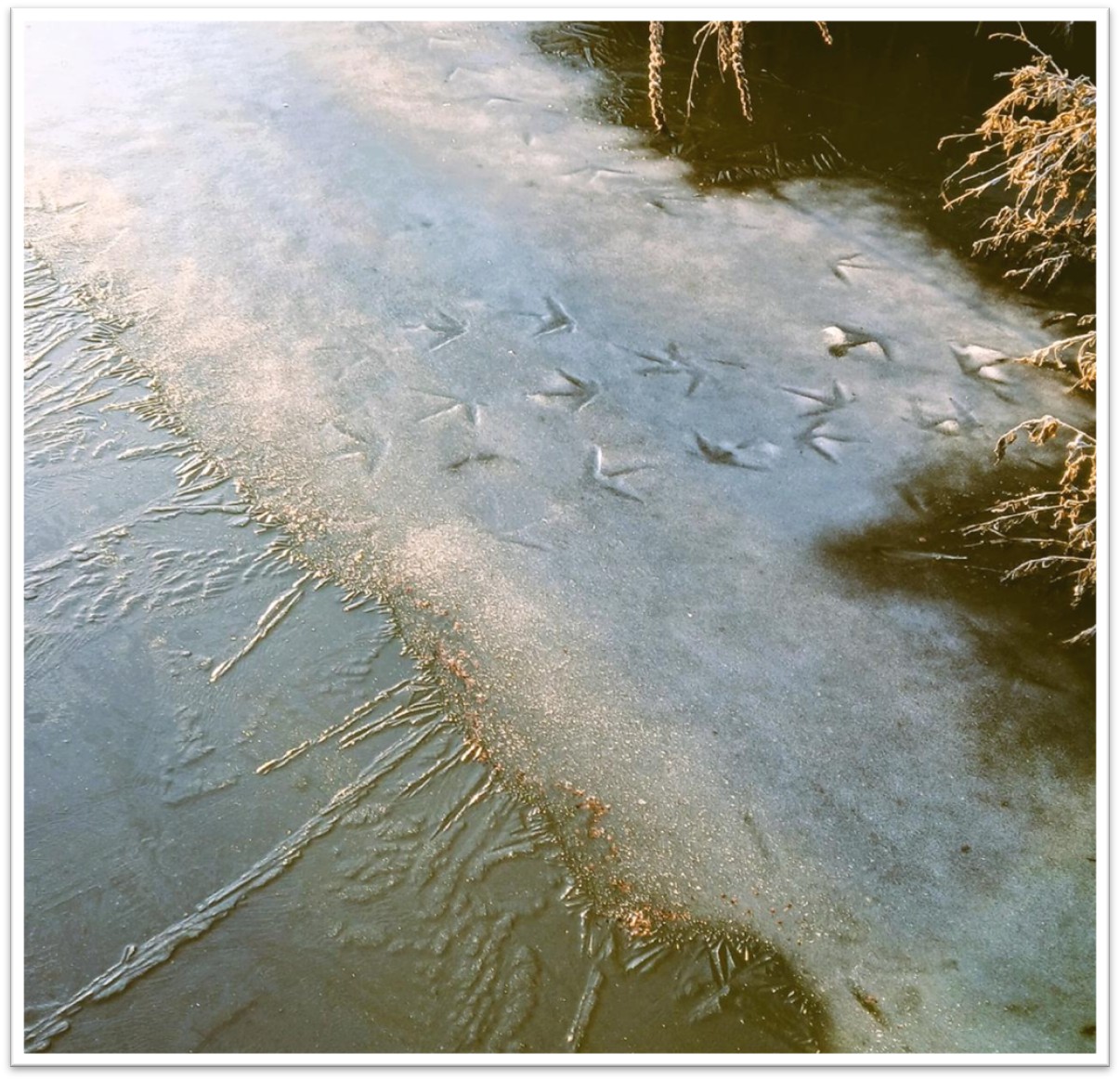 Ice alongside the boat, re-frozen many times, showing footprints and thaw markers
For a video diary of the Whitchurch Breach see Paul and Anthony’s Narrowboat Life Unlocked.
Their real-time footage of the breach can be viewed here: Major Breach on the Llangollen.
For Prof Tim Wilson’s analysis and comment on the place of canals in Britain, see: The Sinkhole in Shropshire.
I also refer to Skempton’s (1996) article on construction of early embankments and cuttings (railways), and the 2025 report by Whitfield Consulting Services .
With special thanks to our lock-wheelersfor supporting this podcast.
Susan West
Ana McKellar
Susan Baker
Mind Shambles
Clare Hollingsworth
Kevin B.
Fleur and David Mcloughlin
Lois Raphael
Tania Yorgey
Andrea Hansen
Chris Hinds
Chris and Alan on NB Land of Green Ginger
Captain Arlo
Rebecca Russell
Allison on the narrowboat Mukka
Derek and Pauline Watts
Anna V.
Orange Cookie
Mary Keane.
Tony Rutherford.
Arabella Holzapfel.
Rory with MJ and Kayla.
Narrowboat Precious Jet.
Linda Reynolds Burkins.
Richard Noble.
Carol Ferguson.
Tracie Thomas
Mark and Tricia Stowe
Madeleine Smith
General Details
The intro and the outro music is ‘Crying Cello’ by Oleksii_Kalyna (2024) licensed for free-use by Pixabay (189988).
Narrowboat engine recorded by 'James2nd' on the River Weaver, Cheshire. Uploaded to Freesound.org on 23rd June 2018. Creative
Become a 'Lock-Wheeler'
Would you like to support this podcast by becoming a 'lock-wheeler' for Nighttime on Still Waters? Find out more: 'Lock-wheeling' for Nighttime on Still Waters.
Contact
- Facebook at https://www.facebook.com/noswpod
- Instagram: https://www.instagram.com/nighttimeonstillwaters/
- Bluesky: https://bsky.app/profile/noswpod.bsky.social
- Mastodon: https://mastodon.world/@nosw
I would love to hear from you. You can email me at nighttimeonstillwaters@gmail.com or drop me a line by going to the nowspod website and using either the contact form or, if you prefer, record your message by clicking on the microphone icon.
For more information about Nighttime on Still Waters
You can find more information and photographs about the podcasts and life aboard the Erica on our website at noswpod.com.
00:00 - Introduction
00:25 - Journal entry
00:54 - Welcome to NB Erica
02:21 - News from the moorings
14:49 - Cabin chat
19:02 - Canal Life (Now and Future)
19:24 - Information on the Whitchurch Breach
31:20 - What does all this mean for the future of canal life?
38:35 - Signing off
38:54 - Weather Log
JOURNAL ENTRY
6th January, Tuesday
“Colder night,
But slightly milder dawn
A few desultory snowflakes fall
Flightless feathers
With no wind
Upon which to dance
Will these small flakes
Ever get the chance
To find the sea?”
[MUSIC]
WELCOME
It's freezing and a night when the moon is in its final quarter. The scent of chimney smoke and frost. The canal is once more glazed with ice, its mottled scratched surface gleaming dully in the cabin lights. The towpath is brittle hard and the grass cracks underfoot. The swim-pools made by winter sun and ducks are freezing over again.
This is the narrowboat Erica narrowcasting into the frozen darkness of a crisp January night.
You made it, happy New Year! How are you? It's a strange old time of the year this, isn't it? But I am so glad you've come. The temperature is still falling and the boats' roofs are beginning to sparkle with frost, so come inside. The cabin is lit by the warm cherry red from the stove, we're snug and safe. The kettle is on and the biscuit barrel is close by. Settle yourself comfy by the fire, and welcome aboard.
[MUSIC]
NEWS FROM THE MOORINGS
The new year has come.
“Without sign or sound
The world slips passed
The arbitrary lines
We invest so deeply in;
The cradling of
Our tears
And the fragile,
Spark-like, flashes of our hope,
And all of our brittle fears.
Passed
Unnoticed, save for
The quickening in the bud
The push new stem
The incremental return of light.”
And the new year now dawns and its long day stretches out before us, with all its light and shadowed shades.
After an autumn and early winter that was very mild and, at times, worryingly warm, so far this year we have been experiencing some proper wintery weather. The new year dawned with some hard frosts and local night-time temperatures dropping to -7° and -8°C (19.4 to 17.6° F) that locked the land and water in ice – in some places making one indistinguishable from the other.
Slowly the ice crept along the canal. It’s grip tightening, reaching out to the spots sheltered by trees and bridges where dark pools of water remained. Swim pools busy with ducks and moorhen, cormorants sometimes joining them. It’s interesting, although these pools offer a much more constricted living space, the normal daily squabbles that often erupt among the ducks when out on open water, seem to be less. Little groups stand around on the ice of the pool’s edge. Their webbed feet teetering at the very edge, like swimmers contemplating taking a dip into an icy pool. They seem quite happy to take turns in and out of the water, without any of that frenetic squabbling that often goes on in large groups on less restricted waters. Perhaps, adversity creates community.
As the days progressed, even these small ice-free spaces began to close up. The only stretch pf free flowing water was down by the bywash of the lock. But even this got progressively slow moving. Then the canal and the boats were completely locked in. On the first day of freeze, a couple of boats crashed through, creating a chaotic icescape of crazy paving. The ice sheet wasn’t too thick and it split and shattered without too much trouble. I felt sorry for the first boat through. It was a holiday hire with a crew new to narrow-boating. The bridge-holes around here are notoriously narrow. Ice never splits in clean straight lines, particularly canal ice that tends not to freeze evenly. The ice kept pushing them into one bank or the other. It was very early morning and they needed to get the boat (and themselves, presumably) back to the hire wharf. They did well, better probably than I would have done. It couldn’t have been much fun after the first couple of minutes.
However, by the next day, the scarred ice was much thicker and everything effectively stopped. Frost piled upon frost, until it felt like snow. The earth underfoot as solid and as unyielding as the water was. Rooks landed centre stream and stood contemplating this new world of theirs. Pairs strutted along together carving small circles of footprints on the powdered surface of the ice. Crows can do anything. Crows can walk on water. For a short time, rooks and a couple of jackdaws became the most common waterbird here. The ducks, by then, having moved away.
From time to time, it tried to snow. However, it was never more than a thin scraping of tiny, frozen pellets. It lay more securely on the canal than it did the fields and towpath, forming a smooth white highway of ribbon that cut a straight path through the iron hard countryside.
We remained warm, although these times can begin to test your heating and at least one nearby boat began to experience problems with their central heating. Fortunately, like us, they have a belt and braces approach and also have a multifuel stove. A couple of boats also began to run out of water. As the water taps had frozen there was little prospect of refilling their tanks until a thaw came. Lack of water because of freezing can be the most significant problem with this type of lifestyle. This is why we always keep an eye on the short and medium-term weather forecasts and make sure that our water tank is filled to the brim before any cold snap. We also institute a very strict water-use policy when the freeze comes. It can mean having to wash in cold water to avoid wasting water in letting the taps run before the hot water comes through. Although, even here, there are little tips and hacks that can help. Using the cold water to fill a kettle enables you to enjoy hot water for washing without having to waste any. The water was back on for a couple of days, although it is once more frozen. However, forecasts show some milder nights are expected from tomorrow.
And then, halfway through the week, slightly milder temperatures ushered in a gradual thaw of sorts. Night-time temperatures hovered around zero, sometimes a degree or so under, but the harsh grip of the freeze began to loosen. Ice-pearled branches and metal railings began to drip. Green and browns began to emerge through the white. The canal surface turned a dull, dark pewter. Heavy mists wept fine drizzling spray that melted the frost and snow crust to grey mush. Drifts of rain also fell, lying flat on the frozen land and water. The fields and towpath became filmed with a thin layer of mud, under which the ground was rock hard and – in places – slippery. Walking across the fields began to feel like walking on a concrete floor covered by a cheap thin carpet.
The thaw was underway, a slow attrition, but it was coming. With the slightly milder air, the winds began to increase. This year – so far at least – the ice has not sung. Just the bangs and booms as the Erica fidgets and shuffles against the ice sheet at her moorings. The unfrozen gap around our hull steadily increased – although never in a linear fashion. Night frosts close gaps made by the previous day’s sun. But the main ice sheets remained. In most places, the canal appeared largely ice free, until you looked closer, or pushed your boot into the water (or watched the ducks). At one point. about a ¼ of an inch of water lay on the surface, driving Maggie mad as she tried to drink. She is fascinated by ice any way, but this was something new. Substantially thinner, the ice still has surprising strength. Large branches and stones thrown onto the canal by children and families at the weekend remain above water. There is something indefinably lonely and forlorn about their appearance. They lie bereft, cast out of place, neither land nor water. Waiting. Waiting for the inevitable. Hostages of the elements. Held frozen (literally) in limbo – a non-space. Can branches and stones have a limbo? If so, this seems pretty close to it. Maggie drags a jagged splinter of ice out from one of the bays. It is only a couple of millimetres thick, but it is unyielding enough for me to wrap my knuckles on it without breaking.
And then on Thursday we were hit by Storm Goretti, the first named storm of the year. There was a lot of media attention about it. The area where we are currently moored fell within the amber warning zone with forecasts of high wind and 30 centimetres (or a foot of snow) of snow. It came in the evening. We spent the hours before it arrived, checking ropes (the rise in water level was our main concern), but also the stern chimney is prone to high winds and so we needed to make sure it was secure – along with all the other things we keep on the roof. Initially, following a drenching downpour, heavy flurries of wet snow fell on driving winds, covering the cabin sides of all the boats like cotton wool sticking to a wet chin. However, later, the snow turned to rain and we woke to flooding pools lying on brown mush. Maggie picked her way through with cat-like precision. I splodged through in gumboots.
The ice is still holding, although the swim holes are getting bigger. Ducks swim unhindered where the tree canopy covers the water. Once again, the importance of trees and their ability to change the micro-climate becomes clearly visible all along the canal. Local bird and animal communities are desperate for these oases of water in the arid tundra deserts of field and footpath. And it is under the trees that the loosening grip of the freeze can first be seen, managed by these wonderful giants who reach up to the sky and under the soil; and the communities that live alongside understand.
My primary worry has been the kingfishers. It needs only a couple of days of hard freeze to wipe out whole families. I had almost given up hope for our local visitors. However, Friday morning, I was greeted by one perched at our moorings, eyeing an open stretch of water around the boats. It flew off when it saw me, but arced around. At the moment, once more, there are plenty of good fishing spots for it.
The spark of hope flashes kingfisher blue.
[MUSIC]
CABIN CHAT
[MUSIC]
CANAL LIFE (NOW AND FUTURE)
A couple of listeners contacted me over Christmas concerning the horrifying news of the canal breach at Whitchurch on the Llangollen canal. Firstly, to check whether we were affected by it and secondly asking for a bit more information on it.
You may have seen some horrifying video of boats being swallowed by what looks like an enormous sink hole. Three boats in total were directly affected. Seven more were left stranded, some at acute angles, due to the water draining away. Two boats that were washed down into the hole, as far as I know, along with one that was dragged to safety from the brink, are still waiting to be recovered. We first heard about it through two vloggers who were caught up in the incident, Paul and Anthony from Narrowboat Life Unlocked. If you want to know more about the breach and the immediate aftermath, I think you can do no better than to go to their YouTube channel. They’re extremely informative as well as providing a very real and very personal account. They were literally moored just metres from the event and caught some harrowing footage of of one of the boats being swept down into breach highlighting how dangerous this event was. It occurred in the middle of the night. One of the occupants jumped from the stern of his boat (into compete darkness) as it was hanging 8ft in the air landing on a bank that was in the process of collapsing and pouring a torrent of thousands of gallons of water down a steep incline. It was an absolute miracle that no one was severely hurt.
It happened on one of the most popular and well used canals, the picturesque Llangollen canal that branches off the ‘Shroppie’ or the Shropshire Union and crosses into Wales where it branches into the Montgomery and Llangollen canals. It is arguably one of the most photographed and videoed sections of Britain’s waterways, featuring the Pontcysyllte Aqueduct (the longest aqueduct in Great Britain) and the highest canal aqueduct in the world.
The first question first – in canal terms, we are a long way away from it and so it hasn’t affected us at all.
The second question is quite difficult to answer as the causes are still being looked into and therefore, we are still working within the realms of speculation until investigations have been carried out and are published. As is too often the case, events like this prompt a lot of wild claims, accusations, misinformation, and general hot air. I have to say that, sadly, the canal and narrowboat forums on Facebook have, once again, not particularly covered themselves with glory. It is a real shame, as the incident has predominantly highlighted the very best of the canal community, near and far, in pulling together in times of adversity. Sadly, in any community you will always find those who feel they have a right for their voice to be heard, no matter how speculative, misinformed, or even malicious. It is just a pity that social media amplifies it.
All that aside, the cause of the breach is still being investigated – And it now seems that it was the breach, the sinkhole, into which those two boats plunged in such a horrifying way, appears to have been the result of the breach rather than the cause. There were some initial suggestions that a culvert that tunnels through the embankment collapsed and was the cause for the collapse. This seems to have been not the case. Inspection and videos of the culvert have shown that it is still sound and undamaged.
The most likely cause, at the moment, appears to be a major failure in the embankment itself. At this point, I want to address a couple of fairly widespread criticisms of the CRT. The CRT seems to have been exemplary in their response to this event and everyone who has been caught up with it. I am have been extremely impressed by the lengths they have gone to in making safe people and boats and as getting as many as possible back onto the navigation. I also know that this has include many volunteers who have given up spare time and braved some really atrocious weather. Once again, the CRT volunteers have proven themselves to be an amazing and truly dedicated band of people. The CRT also responded with River and Canal Rescue to do an amazing job in quickly stemming the breach from both sides, and then refilling drained sections. Again, there has been some questions why they responded so quickly to this breach, when their response to the breach on the Bridgewater Canal the occurred a year earlier (almost to the day) appeared to be slower. Some posts have suggested that it was because the quick response to this breach at Whitchurch was because a couple of very popular vloggers were posting material on it to a worldwide audience. This was not true. The Bridgewater Canal is privately and therefore not under the purview of the CRT. The CRT could only become involved when and if invited by the owners. The presence of Paul and Anthony from Narrowboat Life Unlocked, together with a couple of other vloggers, was not the reason for the swift response.
Another claim has been that this is yet one more example of the result of CRT withdrawing or cutting back on maintenance. Whilst, I have my own feelings about some of the more recent policies on infrastructure maintenance, it is clear that the safety and integrity of the system for both users and those around has not been affected. The CRT regularly inspect all embankments and this one was reported to be last visited in November 2025, just a month or so before the breach. Moreover, there is continuous monitoring of water levels throughout the system, and it was this in fact, that alerted the CRT to the problem, and enabled them to be putting together a response, before even the emergency services contacted them.
The cause for this incident seems to suggest a more deep-rooted problem than simply lack of maintenance. It is looking increasingly likely that the reason lies in a long-standing problem associated with Victorian era (and earlier) embankments. This concerns rotational soil: This refers to the occurrence of a circular or arc-shaped slide and is a particular challenge for the maintenance and safety of rail services as well as canals. It is due to a technique used in their construction called ‘end tipping’ also known as ‘the top-down method’. This was a practice that was adopted to accelerate the progress of the construction of the embankment, prioritising speed over stability, and involved running spoil from cuttings, tunnelling, etc. to create the needed slope either floating boats along the channel being constructed or, latterly, wagons running on temporary rails. There is a link in the programme notes to an article by AW Skempton explaining this procedure in much greater detail. This meant that these structures were often built rapidly using uncompacted and poorly prepared materials. Over the two hundred or so years, many embankments have undergone gradual degradation and progressive failure due to a process termed seasonal "shrink-swell" cycles. This refers to the expansion and contraction of clay soils from wetting and drying, and which reduces the soil's strength and slope integrity over time. This, in turn, can exacerbate rotational soil shifts within the embankment and give rise slope slippage or even collapse.
Changes in climate with increased occurrences of very dry spells followed by very heavy rain (the Whitchurch breach followed one such downpour), has also served to heighten this problem. In fact, a report published in August last year by Whitfield Consulting Services. argues that data shows that issues relating to slope stability of railway embankments because of climatic changes have become much greater with the increased risk of failure and warn rail companies and network rail for greater vigilance.
How to deal with this is more problematic. For railways, a number of methods are used that include among others, geo-polymer injection and sinking steel sheet piling into the ground. For canals, there are also a range of techniques used, from clay relining, sinking underwater concrete bags as well as soft engineering that include using coir matting, hazel wattles, and reed planting. However, all of this takes time and is very expensive. It is estimated that over the next 5 years, embankment remodelling and repairs will cost Network Rail around £1bn. This cost is beyond anything that the CRT could cover. Currently, unlike the rail system, the canal system – for a number of significant reasons - is not viewed as a national asset. Following the Whitchurch breach, Prof Tim Wilson recording one of the best analyses on the place and importance of canals that I have heard or read. I include the link to his video in the notes: https://youtu.be/p8604sOQdS0?si=pANIuhjdtRFYPEom.
There has been some talk about what does this all mean for the future of the canals. Coming on the back of a year when large sections of the canal had to be closed due to low water levels, I can’t help feeling that we are at a cross roads, or, at least, at a point where life on the canal is about to change. It is probably too early to be certain, and a couple of years of gentle weather and good luck may restore some confidence back into the boating community. However, I know that if I had booked my main holiday on hiring a boat, only to be told that the canal was closed, I would think twice in doing it again. The hire companies must have also been hit hard this year. However , even private boats, leisure or live aboard have also been affected. I personally know of a couple of boaters who have been unable to return to their home mooring and are having to winter elsewhere – and the extra financial burden that it is putting on them. Furthermore, I am also aware when away from our home mooring, the thought is becoming more prominent in my mind about what happens if a major failure occurs (for example the closure of a lock for a couple of months), will I be able to get back? Simply following an alternative route is becoming more of a challenge. The danger of being completely stuck and needing to be craned onto a lorry is becoming a worrying reality for some.
I do wonder how many owners of leisure boats, who would normally take out their boat for four to six weeks in the summer, will decide that it is simply now just not worth the risks and current realities are just getting a bit too much. Again, I know of a couple of owners who simply haven’t been able to go anywhere this year. Which leads me to wonder how many boats will be going up for sale and also who will buy them, now the dream of drifting carefree around the network is becoming much harder to realise. I'm also concerned for the itinerant canal traders who rely on a regular schedule of canal fairs and markets.
I am not saying that this is the end of the canals or life on the canal. I certainly don’t want to frame it in those terms. In fact, I think that it's far from it. I just think, it is going to be different. Sections of the canal are becoming more frequently unnavigable, more unplanned closures means that the old idea of sitting beside the cabin fire in the depth of winter and pouring over the canal maps to plan the year’s adventures is not so practicable. Just watching the vloggers who are constant cruisers, repeatedly having to adapt and change plans is testament to that.
Nothing is as certain as it was – that seems to be the mantra for the 21st century, doesn’t it? Adapt and being prepared to change, I think is the key. In many ways, that is what life on the canals typifies and it is what attracts so many of us to this life. May be, eventually, canal life will be more about the quality of living on the canal rather than about mobility. Maybe it's a chance to rework our relationship with the canal. I know only too well the siren lure of nomadism and to constantly want to see round the next corner. However, the canal can too easily become just a means to the end of meeting some deeper more complex need. Skating on its surface like those rooks on the ice. Visitors passing through on the breath of chance and opportunity. Perhaps, this is a chance to recheck our compasses. To slightly misquote an idea from Ken Jolly, to become a people who don't just pass through this world of water and towpath on a boat, but who actually find a way to become part of it. To belong to it. To meet the canal with open hands, and just not only with a hand tightly closed around the tiller. I am not sure. As I say, maybe a couple of good years will reset everything. Maybe that would be a good thing. I don’t know. But I have a shrewd feeling we are at a point of transition between an older world and its ways and expectations and a new one in which we need to discover newer ways of approaching and doing things - or maybe rediscover even older ones. That we are entering a new phase in canal-life; one that offers both new excitements and experiences, as well as challenges. The one remaining constant is that canal life teaches you one thing, and that is whatever the challenge, it is possible adapt and change to meet its demands.
SIGNING OFF
This is the narrowboat Erica signing off for the night and wishing you a very warm, restful and peaceful night. Good night.