The Remarkable Tale of Bertrum Crane (A story for Christmas)
It's Christmas on the canal, and the time when we traditionally gather around by firelight and tell stories of wonder and magic. So, tonight, there is an extra specially warm welcome aboard the Erica as we turn the lights down low and listen by firelight to a rather remarkable (and I think wonderful) tale of canal-side Christmases past and the magic hidden along the towpath. Grab a mug of your favourite drink, settle into your cosiest chair and join us into the heart of a canal...


It's Christmas on the canal, and the time when we traditionally gather around by firelight and tell stories of wonder and magic. So, tonight, there is an extra specially warm welcome aboard the Erica as we turn the lights down low and listen by firelight to a rather remarkable (and I think wonderful) tale of canal-side Christmases past and the magic hidden along the towpath. Grab a mug of your favourite drink, settle into your cosiest chair and join us into the heart of a canal-side Christmas.
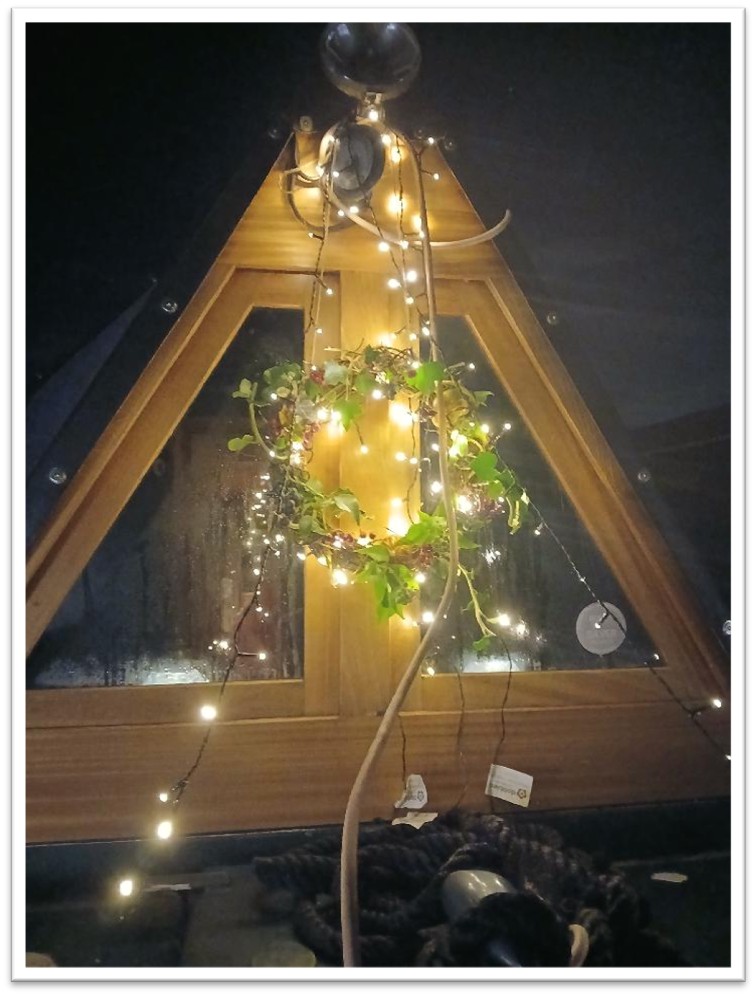
With special thanks to our lock-wheelersfor supporting this podcast.
Ana McKellar
Susan Baker
Mind Shambles
Clare Hollingsworth
Kevin B.
Fleur and David Mcloughlin
Lois Raphael
Tania Yorgey
Andrea Hansen
Chris Hinds
Chris and Alan on NB Land of Green Ginger
Captain Arlo
Rebecca Russell
Allison on the narrowboat Mukka
Derek and Pauline Watts
Anna V.
Orange Cookie
Mary Keane.
Tony Rutherford.
Arabella Holzapfel.
Rory with MJ and Kayla.
Narrowboat Precious Jet.
Linda Reynolds Burkins.
Richard Noble.
Carol Ferguson.
Tracie Thomas
Mark and Tricia Stowe
Madeleine Smith
General Details
The intro and the outro music is ‘Crying Cello’ by Oleksii_Kalyna (2024) licensed for free-use by Pixabay (189988).
Narrowboat engine recorded by 'James2nd' on the River Weaver, Cheshire. Uploaded to Freesound.org on 23rd June 2018. Creative Commons Licence.
Piano and keyboard interludes composed and performed by Helen Ingram.
All other audio recorded on site.
Become a 'Lock-Wheeler'
Would you like to support this podcast by becoming a 'lock-wheeler' for Nighttime on Still Waters? Find out more: 'Lock-wheeling' for Nighttime on Still Waters.
Contact
- Facebook at https://www.facebook.com/noswpod
- Instagram: https://www.instagram.com/nighttimeonstillwaters/
- Bluesky: https://bsky.app/profile/noswpod.bsky.social
- Mastodon: https://mastodon.world/@nosw
I would love to hear from you. You can email me at nighttimeonstillwaters@gmail.com or drop me a line by going to the nowspod website and using either the contact form or, if you prefer, record your message by clicking on the microphone icon.
For more information about Nighttime on Still Waters
You can find more information and photographs about the podcasts and life aboard the Erica on our website at noswpod.com.
00:00 - Introduction
00:23 - Welcome to NB Erica
01:46 - The Remarkable Tale of Bertrum Crane
01:20:12 - Signing off
01:20:37 - Weather Log
WELCOME
It is Christmas time, canal-side. The world, beyond the hedgerows and the fields with their wooded spinneys and dells, the threaded country lanes and scatter of houses, rushes on it is celebrations and noise. But here, a peace descends with the night. The rushes stand silent under the spreading arms of oak and ash. The deer are awake, the fox and owl too, and we share this silent night with them.
This is the narrowboat Erica narrowcasting into the darkness of a Christmastide night, to you wherever you are.
Ah well done for making it. It is so lovely to see you. Let’s spend some time to enjoy this place of quietness amidst all the bustle of a festive night-time. The cabin is warm; the kettle is whistling on the stove. So, come inside, and welcome aboard.
[MUSIC]
THE REMARKABLE TALE OF BERTRUM CRANE (A STORY FOR CHRISTMAS)
Christmas has come to the cut, and with it comes that feather-soft feeling of contemplation and reflection. By firelight, old Christmases whirl like snowflakes bringing old friends to mind. It is also a time for sharing stories and there is one in particular that has been on my mind recently.
I will always associate Christmas with an old and good friend of mine, Bertrum Crane. Although he has passed on from this world a good many years ago, that damp, piney smell of spruce or fir that rises on the evenings of the pre-Christmas long nights, or the flame of holly berry, and candle fire, the tart-sweet taste of mulled wine (spiced with cinnamon and clove), and the loops of paperchains that mimic the flight of kingfishers along the bankside, or catch sight of a festively decorated tin of assorted biscuits (all robins and sleighs and snowflakes), all these never fail to evoke in me memories of the tall, stooping figure of strange Mr Crane. And on this Christmas night, I think it would be as good a time as any to tell you the story of Bertie Crane (as I came to know him) because it is remarkable and, I think, in its way, rather wonderful.
My earliest memories of him was in the long ago summer when I was still a lad and I tagged along with the village boys (who were slightly older than me) and my school mates through the patchwork of fields that bordered our small world, to make dens and plan blood-chilling exploits, use the glass of an old pocket watch that belonged to Smithy’s grandfather to try to light fires with piles of dried leaves, and catch sticklebacks and caddisfly larvae in the canal that cut through the bottom half of the village. And it was on these ventures along the ‘cut’ that I first became aware of this rather mysterious, and to us, slightly eerie figure of Mr Cane.
Bertie Crane lived on the outskirts of the village, about three-quarters of a mile up the canal, in a late Victorian white-washed, lock keeper’s cottage, just passed Lock 69, where he lived alone. Word was that he was once a lock keeper. In fact, some of the village old-timers sometimes referred to him as ‘Lockie Crane’, but the days of lock keeping around these parts had vanished long ago. These were the days when the canal was in great decline. The Transport Act of 1962 had brought the creation of British Waterways, and like many who still worked the canals, Mr Crane found himself under new employers. The steep decline in water haulage meant that his job as lock-keeper was felt but the suits up in London, to be no longer tenable. New work on the canal system was found, and it involved duties that were clearly varied and wide ranging.
By all reports he was a figure much respected for his knowledge of water and his skills at managing the flow at times of drought and flood. Even though, historically, certain stretches were notorious for breaching or flooding, under Mr Crane’s steady eye and hand, there was never a single incident when the stretch under his guidance became unnavigable. Only the savage ice of hard winters could ever bar the passage of boats through his section, and this, it was felt was taken by Bertrum Crane as a personal affront. It was said that, during these times, his tall stooped figure could be seen, motionless for hour upon hour, glaring down into the dark glassy, ice-held water as if his gaze alone could melt it. Later, when I had got to know him personally, I noted that it was only during these times of hard freeze that I ever noticed him showing signs of perturbance and, if prolonged, irritation and even annoyance.
Years later, one glorious spring day just below Tardebigge, I was chatting at a lock to watch a boat pass through, the way one does, to an elderly gentleman who had identified himself as an old BW (British Waterways) man. In the course of our conversation, I asked if he had ever come across a Mr Bertrum Crane? “Ah, yes,” the old timer said, leaning back on the balance beam and enjoying the warm spring sun. “Bertie Crane! You knew him? Now there was a man who understood the canal.” He stood for a while, a far-off look in his eyes. “That man was a legend, even in the critical eyes of the old working boaters, who viewed us BW types as Johnny-Come-Lately up-starts.” Together, we watched in silence the water level inch up the lock chamber. My new friend seemed to be lost in an older world that swum unseeingly in front of his eyes. “You know,” He started again, tearing himself back to the present. “It takes many years to gain knowledge of the ways of the water. I mean properly know it. And I don’t mean like that which can be picked up in a fancy text book or through the chalked lines on a classroom blackboard. I mean know it. I am still learning…” his voice trailed away. “But Mr Crane, now there was a man. He didn’t just know about water, he understood it. It was like he spoke its language. When he looked at a stretch of water, it was as if he could see things beyond our knowing. He saw currents beyond our seeing. The way the water temperature shifts with the play of sun and tree shadow. I tell you this, it was uncanny. Some of us were proper spooked by it. ‘Unnatural’ some called it and they shunned him. One guy, you might have come across him as he worked for a while down your way, he refused to work with him. Said Crane gave him the creeps, the way he stood stock still staring into the water. Our gaffer wouldn’t have it at first. Said “‘ow else was he going to gauge the levels for the bottom sluice?” But in the end, he relented and the guy got a transfer up to, I think, Etruria.”
It was true though. Even as a nipper, trotting beside the canal, dangling a jam jar held by a loop of string tied around its neck and filled with cloudy water and frog-spawn, I was aware that there was something strange about Bertie Crane. Like all youngsters, I never thought to enquire about him, other than accept his presence in the world as one does an old oak, or foxes, or, indeed, grandparents. They all just are. Without beginning or end. I have no recollection of my first awareness of Bertie Crane, in the same way I cannot recall the first time I encountered blackbirds or rooks, rain or grandma, Bertie Crane was a presence that was always there. He was just one more part of the long straight world of the canal in the same way as the rows of crack willow down by the fisheries, the gritty coal dust that flecked the towpath where John Dicko’s wharf used to be, or the stands of bullrushes where I’d happily fish for tadpoles.
And so, Bertrum Crane came to us as one, like Melchizedek, “Without father, without mother, without descent, having neither beginning of days, nor end of life.” The distant shadow of his presence along the canal-side neither questioned nor commented upon, as much part of the accepted and expected landscape as the great brushes of bullrush and dragonfly dart, and the sigh of willow leaves in summer rain. Just as they had always been eternally a part of the canal, so too was he. A soul grown organically from towpath mud and wet brick and wood, moss and water rush.
You never really met him or ‘bumped into him’ walking along the towpath, as you would other people. We rarely saw him up close, just snatched glimpses of this distant, strange, stooping figure, plodding birdlike along the towpath or standing in absolute stillness by the water’s edge. Have you ever experienced gazing at a scene only for an unnoticed shape to resolve in your vision and discover a cat, or an owl, has been standing staring at you, all along. That was often the case with Mr Crane, a shadow resolving into a distant motionless figure standing beside the canal among the reeds, or waiting (for who knows what?) by a lock. More often than not, he’d seem to be lost in thought staring straight down into the water, as if he was reading its silent flow of words. At other times, he’d be raking died-back reeds and twigs with easy fluid motions. However, for the most part, by the time you approached near to where he had been sighted, he had gone.
In truth, we village lads were more than a little afraid of him. The straight posture and precision of his strange gait, usually with hands folded behind his back. The sense of an almost alien stillness that he seemed to exude. His dark hair, swept back, into a glossy helmet with Brylcreem, as was the fashion then. Perhaps, the most striking thing about him, although, not always noticeable was his piercing gaze. His eyes, peculiarly light brown in colour had a quality about them that seemed both worldly and unworldly and seemed capable of taking everything in, no matter how small or how insignificant. Later, when I got to know him much better, there were times when I became captivated by them. He’d lean over to pluck a biscuit from his biscuit tin and in certain light, at certain times, it was almost as if his eyes were dusted with gold. Come rain or shine, heat or cold, he always seemed to wear a capacious Gaberdine mac. These were the days long before polar-tec clothing designed for high altitude mountaineering had become the required clothing for a stroll down the towpath or across some rolling pastureland. When the rain got heavy, he’d often simply throw a hessian sack over his shoulders. The long mac, flailing in the wind around his legs.
He struck an austere figure to us lads. His appearance was a little too like that of a headmaster or some other stern symbol of authority whose life’s presiding work was out to crush all joy from our boyish world. As we boys grew older and bolder, our exploits took us on longer forays along the canal. One year, we made the railway bridge our gang headquarters – it was just far enough along the towpath not to get too bothered by dogwalkers and courting couples. Inevitably, our worlds began to collide. I have no evidence to suggest that he viewed us in any way negatively, beyond a noisy irritation that dropped chewing gum wrappers on the ground and chalked initials on the bridge walls. However, for our part, a definite antagonism began to develop. We came to see him as the fierce custodian of all things aquatic and as such, he became our sworn enemy whom we had to thwart at all costs. “Old Crane seed you last night and is after your skin.” Someone would say to us and morning playtime. “’E’ll put you in a sack and drown you in the lock like ‘e does puppies.” And our blood would curdle and we slink low and as silent as weasels along the towpath for the next couple of days, our hearts hammering in our ears at our sheer bravery and audacity.
As is too often the case, fear, particularly of those who don’t seem to quite it in, evokes a cruelty and he was subject to more than a few rude and insulting names and rhymes. And, I am saddened and ashamed to admit it, these came not just from us village lads. Villages, particularly in those days, could be hard, harsh, places for those it deemed as not fitting in, and Bertrum Crane did very little to fit in. A silent, reclusive figure, he preferred to keep himself to himself. I suppose that it was like a lot of those who were part of the network of working boats and who were used to being treated as outsiders and viewed with a certain amount of hostility and suspicion wherever they went, he had learnt the value of remaining on the village’s margins. Perhaps he got so used to it, maybe he had grown to prefer it. Coming into the village once or twice a week. The only shop I can recall him visiting was the fishmonger, who sold fish on a flat iceberg of a counter, that dripped fish scales and arctic water onto the slick tiled floor. His shop fronted an old villa that was uses by Dr Mawson, our local GP, for his surgery. Of course, villages being villages, rumours and talk were rife about this outsider who strode, long-shanked, so silently into our community and departed often without a word or even a nod of acknowledgement to a muttered “How do, Mr Crane.” There were hints of some tragedy, usually involving the still, dark waters of the cut and then adjoined with cautions about us messing about too close to the cut. Kinder hearts would sometimes, tearfully shake their heads when his name was mentioned, wrapping distraught hands deep inside pinafore pockets and say, “Poor Mr Crane. What must have that poor soul ‘ave gone through to make him like ‘e is today?” Not all were so understanding, though. “Where’s ‘is woman?” I heard one woman ask, as I stood with my mother in the queue to be served at the greengrocers. “T’aint natural, a man living alone out there, like that.” She fumed. I was still very young, perhaps 7 or 8, at the time. But her words struck me hard, because, even then, I had begun to suspect that the problem with Mr Bertrum Crane was not that his life was unnatural, but that it was perhaps a little too natural.
However, there were also rumours of darker deeds in his past as the cause for his solitary style of life. In this way the wrapping mists of rumour, hearsay, and mistruth – both well-meaning and malicious – serve to form a myth which paints the man, all of which fuelled the feverous imaginations of our school-boyish minds casting this solitary lock-keeper into some doomed figure blighted and cursed or even a fugitive vainly trying to wash his hands clean of spilt blood in canal water. George Baxter, the son of the preacher at the Strict Baptist Zion chapel, even swore on the Bible (smuggled from his house) that one night he came across Ole Craney and he could clearly see the mark of Cain glowing on his forehead. In these small incremental ways and enmity between him and us built up. Mr Bertram Crane became the personification of all those malign imagined forces that were out to deprive us of our freedom and joys. Ole Craney took on the role of the neighbourhood boggart, an unhuman devil against whom, we village lads could pitch our bravery and derring-do. His lock-keepers cottage became the focus of countless games of ‘knock-down-ginger’ when, with beating hearts we’d creep up to his front door, en-masse, all scabby knees and untied shoelaces, breathlessly let the big brass door knocker fall and then tear away, eyes white with the terror of it all. From behind bramble bushes, of which there were plenty, we’d wait for the door to be answered. It very rarely was. Mr Crane had other things to do with his life than wait around at home for the entertainment of the village juveniles.
It all came to ahead when one summer, when Southey, one of the local farmer’s sons, joined us in the fields above the village, known locally as ‘The Drift.’ The holidays were stretching eternally before us, and as youngsters, we were getting impatient with paradise. We’d made a den and had tried boiling water in a tin can over a fire that we had managed to light. It was true, honest and rustic, backwoodsmanship – the type no longer encouraged among today’s youth. We had piled up some dead grass, dried leaves and a few sticks forming them into a wigwam. We then poured a good pint and a half of petrol over it (drained from a father’s motorcycle), and lit it with a Zippo lighter ‘borrowed’ from another father. The result was as spectacular as it was short-lived. We sat around, staring at the circle of scorched earth, rubbing our foreheads were our eyebrows used to be, and wondering whether our mums would notice when we got back home. “This is boring.” Gazzer said. This is when Southey, lying on his back and staring at the clouds, said, “We could go shooting.”
Southey had been in receipt of an air rifle that previous Christmas. In fact, many of my slightly older school friends were owners of rifles. It gave them an air of prestige or cachet in the playground. Instantly, adding years to their age and cloaking them with an aura of mystery as they’d talk in serious tones about “.22s” or the benefits of ‘pointies’ over ‘wadcutters.’ The rest of us relegated to gawping bystanders could only watch enviously from the distance. Times were different then, and although the Fire Arms Act was technically in force, within farming communities like our village, blind-eyes were often turned. In fact, owning an air rifle was a rite of passage and was the dream of most boys – including me, although my parents had forbidden me from having one. Southey ran back home to get his ‘shooter’ and we then all traipsed down to the cut to put up milk bottles on one of the buttresses of the railway bridge.
I am not sure who came up with the idea, maybe it was one of those fateful inevitabilities upon which life seems to run, but we eventually found ourselves on the opposite bank to Mr Crane’s cottage. Us lads had had a couple of run-ins with him recently. We had got lippy and our encounters were belligerent and, I am afraid to say, downright rude. I don’t remember Mr Crane’s responses to our misbehaviour as being anything out of the ordinary. In fact, looking back, he was actually remarkable phlegmatic about the whole thing. However, there was something disturbing about his demeanour. The look he gave you in return to a jeering remark. He never needed to lay a finger on you, just that look from his piercing golden eye that seemed to cut straight through you. In many ways, this was the worst type of reaction. Fisticuffs or being taken by the ear to have a word with PC Blackmore (our local bobby) and then the inevitable scalding from our parents would have likely brought things to ahead and lanced the boil of our animosity.
However, a few weeks earlier, he’d caught a group of us messing around near the lock and throwing stones at an abandoned boat that had been tied up there. That time he did, and with hindsight quite correctly, did react. Our pride and dignity still stung at, what felt to us at the time, his heavy-handed bullying and massive over-reaction. Muttered talk, at playtime and after school, revolved around dark plans on how we should get back at Ole Craney. No longer a dark cloud on the distant horizon of our carefree freedom, he had now become our full-blown and towering nemesis. Even so, I remember that I was not the only one who felt more than a few qualms when Southey appeared breathlessly across the fields, air rifle tucked under his arm. Southey was an ungainly, bulky lad, a couple of years older than the rest of us. Whenever he joined our gang, he naturally took the role of leader, quelling any dissent over decisions with a vicious mastery in the administration of Chinese burns. Consequently, we sullenly tended to defer to his age and wisdom.
To this day, I don’t remember how we got to be opposite Mr Crane’s house. I dimly remembering Southey letting some of the boys have a go at shooting at a Corona bottle someone found in a ditch. The fact remains that we did. Scrambling on our stomachs like the snipers pictured in our weekly comics, Southey draping some bracken over his head for camouflage. “Let’s teach ole Craney a lesson.” He hissed, “Teach ‘im to boss us around.” A couple of the other boys murmured, “Yeah” or something like that. Most of us lay where we were, frozen to the spot – not with fear, with something deeper, more primal, less explicable. I remember watching with the disconnected sense of unreality as Southey look down the barrel of the rifle as he levelled it towards the house.
“Is he in there?”
“Yes, bound to be.”
“Good. He deserves it.”
The barrel steadied.
Then Ginger, one of the younger lads suddenly said, “No! You mustn’t.”
Southey turned on him, his face contorted with such violent disgust and derision. “Oh, don’t be such a pathetic shrimp.” He spat out. The venom in his voice quelled any other possible voice of dissent.
“Let’s do it!” said Gazzer.
“Amen.” Said Baxter, quietly.
Ole Craney did certainly need putting in his place.
“Agreed?” Demanded Southey
“Agreed.” We all murmured.
Again, the rifle steadied, and Southey’s sausage-thick finger caressed the trigger.
And then it came.
A crack. A simple, single crack. That shook our entire world.
We watched spell bound as the window next to the front door of the room we knew the Craney used as his sitting room suddenly turned silver-white and then disappeared. I can remember thinking that it was like the snap you get when you bend a pencil in half. It was almost like magic. An awful, terrible magic. A magic that no one would laugh or clap their hands at, or say how clever. Was this the magic of the world I was growing up into one that instead of casting a spell of wonder and enchantment, disinvested the world of it. A magic of disenchantment.
I remember too, the noise of tinkling glass as the window turned opaque and then was gone.
I can still hear that pop and the desolate broken, tinkling sound of falling shards of glass. I sometimes still hear it even in my dreams.
And then came a barking cry coming from inside the little whitewashed cottage beside the lock which had shared so much of our childhood. A cry filled with anger, outrage, shock, but also in that harsh note, I could also detect sadder tones of hurt, maybe betrayal.
We ran. Some of us, I think were crying. What had we done? What unspeakable, unthinkable act had we committed? That day, we lost our Eden, not through some divine exile, we ran from it because of our fears and our misunderstandings of the world that we had still not come to terms with. For many years we never returned to the canal or the towpath, or the scene of so many boyhood memories. In fact, from that moment, our little gang of village outlaws all but disbanded. I think, even Southey, realised he had gone too far. He no longer joined us, when in ones and twos we tramped the fields and the wood. He wouldn’t have been welcome even if he had. The mystery of manhood and all that he represented too had been dispelled. We had glimpsed behind the smoke and mirrors of the adulthood and seen the child that would (or, perhaps, could) never leave the man.
Mr Crane, as far as we knew, never said anything – although with that penetrating gaze that nothing could escape, he would clearly have known the perpetrators behind the atrocity. However, that did not relieve us of many sleepless nights. Gazzer reckoned we could go to prison. Ginger, whose dad worked in some sort of legal firm in a nearby town, kept using the words “custody” and “criminal offence.”
Boys can be resilient creatures and, in time, we bounced back. However, we kept well away from anything to do with shooting or rifles, and we gave the canal a wide birth. The odd time when Bertrum Crane came to the village, we always politely called him ‘sir’ and step off the curb to respectfully let me pass. It should also be noted that, even years after the event and even when it was just amongst ourselves, we never referred to him as Ole Craney ever again. We always would say, Mr Crane. It must also be said, on those brief and accidental meetings, Mr Crane never once showed any sign of recognition or gave any indication that he bore us ill will. He’d look at us, in the manner that a fox observes a magpie or heifer and simply pass on his way, hands tucked behind his back, the tails of his gaberdine mac trailing along behind him.
But the call of the cut was, for me, a strong and insistent one, and one that I found increasingly difficult to deny. I was by now in my mid-teens when I, once more, began to make short forays down to the towpath. Now no longer in shorts and clutching fishing net and jam jar, I was content to spend time watching the reeds bow and bend to the breeze that often blew down the canal, or spend hours sitting by the weir, near old Toovey’s Mill, watching the water sparkle and dance, and the long reedy tendrils of waterweed that grew on the bed just a foot or two below the surface. I still kept well away from Mr Crane’s cottage, but began to enjoy revisiting old haunts that had been so much part of my growing up. From time to time, I’d catch sight of Mr Crane, usually in the distance, and just as usually he was statue still, watching or reading something unknown in the waters. A few times I would nod in his direction as a form of greeting – or acknowledgement of his presence. Often the nod went unanswered. But once or twice, it would be returned. And, those rare occasions, would incomprehensibly fill me with a strange flush of achievement and in some small way, a sense of atonement.
Now, at this point, you might well be quite understandably thinking, this is all very well, but you said at the start that this was a Christmassy sort of story and, up until now, it doesn’t feel very Christmassy at all, in fact, far from it. And you are absolutely right. But this is where the story of Bertrum Crane takes a remarkable turn.
As the years passed, I grew through those jagged years of adolescence into adulthood. My fondness for birds developed and the canal became my favoured spot for ornithology. Meetings with Mr Crane were curt but polite and, in every way, unnoteworthy. Then, when I entered my twenties, I had cause to move away and relocate in the midlands. However, my interest in the canals not only remained, but began to grow. A very fleeting, but doomed romance with a girl who lived on, what I later learnt to be called, a narrowboat, opened my eyes to the possibility of living what seemed to be a carefree and nomadic life afloat. I became so infatuated by the idea that a few years later I began to view it with a greater seriousness. Wanting to make sure that I wasn’t making an awful and expensive mistake, I decided to take things slowly. My plan was to hire a day boat and then, if that went well, to hire a narrowboat for a week over the following summer. Finances always being tight, I therefore booked a dayboat in the slack period on the week running up to Christmas. I was a little taken aback when the boat operator’s first question on taking my call inquiring about a day hire in the first week of December was, “Really??! Are you sure?” Undaunted, I went ahead with my booking. The hire boat wharf was only an easy forty or so minute drive away and I knew that the stretch of canal it was on was renowned for its beauty and characteristic bridges and barrel-roofed lock-keepers’ cottages.
That is how I found myself forlornly standing on the stern deck of a little (although, it didn’t seem so little to me at the time!) 30ft narrowboat in a lashing sleety squall. I was having a hard time of it. Truth be told, I was making a complete dog’s breakfast of it all. I was making a hash of steering, the tiller failing to do what I expected, and was constantly veering at 45 degrees down the canal and repeatedly burying the bow into the thick bankside vegetation. When I did manage to gain a semblance of control a wind gust blew me off course. Some of the bridge-holes were confoundedly narrow, my sodden feet felt like blocks of ice, and my hands ached. My dreams of living on a boat were sinking as fast as was my mood. It was, therefore, in this miserable state that I was encountering my second lock of the day. I had already begun to bitterly regret my blithe refusal to invite any friends along to help – although, I suspect that the number of friends who would have volunteered for such a trip at this time of year would have been shockingly small. Single-crewing through a lock I found was not as easy as I had originally assumed. As I neared this second lock, I realised that gate was already open. Fortune seemed to at last be favouring me. I nosed the boat into the lock chamber. Once in, I began to scramble onto the cabin roof, my trainers squelching noisily, in order to climb the rusty ladder set into the chamber’s wall to climb up onto the bank. I was halfway up, when a disembodied voice suddenly broke into my consciousness.
“Hey, there boy! Would you welcome a hand to help your passage through?”
I needed no second thought, “Yes, please!” I was ready to accept help from anyone, no matter the strangeness of their syntax.
“Stay aboard, then.” The voice replied. “Watch the cill. The water will draw you away from it, but watch your bow fender on the up gate.”
“Right.” I yelled back uncomprehendingly; my voice being swallowed by the rush of water and the curling squall of wind.
Large wet flakes of snow slapped against the cabin roof and on the meagre covering of my jacket hood. The owner of the voice must have picked up on the nervousness and incomprehension in my voice. For the rattle of the sluice paddle stopped and it came again. “Forget trying to think like you’re on a boat. Read the water. The water tells you everything. The boat has no mind of its own, but the water does.”
I brushed away a flake caught on my eyelash and waited shivering as the boat slowly rose in the lock. A belt of full-blown snow suddenly whipped across the canal obscuring visibility to a few feet. I could barely see the boat’s prow, let alone the lock gate a few feet further on. Slowly, through the swirl of flakes a lanky, slightly gaunt and slightly hunched figure appeared. His slow fluid movements, curiously birdlike. For a split second, my mind whirled back to my childhood, the dizzying whirlpool of splintered fragments of memories, and unidentified emotions.
“I tell you what, lad, you certainly picked a day for it.” The whip of an ancient gaberdine overcoat cracked in the wind.
“Mr Crane?” I shouted, before I could even stop myself.
He paused; his head cocked on one side looking down at me from his vantage point. I was aware of his gaze. A gaze that seemed to take everything in. I am not sure whether or not he recognised me. I was, after all, just one mischievous, hot-headed village boy among many.
“Two more feet and you’ll be through.” He said, turning to return to the paddle.
Silently, we worked the lock. I got out and closed the offside ground paddle, while at the seemingly gentlest of touches, the lock gate sprang ajar, and casually, leaning with his back to the beam, the gate slowly opened.
The last blizzard-like squall seemed to blow the storm out. A desolate rime of grey slush clung to the grass verge. I realised that I was shivering uncontrollably.
He looked at me with a quizzical expression and a glint of humour in those familiar eyes. “Boy,” he suddenly said, “You’re half frozen. Tie up here and come inside to warm up for a while. You’ll be catching pneumonia if you don’t watch out.”
It was only then I noticed, just below the lock, stood a small barrel-roofed cottage with its deep-red door and smoke curling from the chimney. An old oil lamp stood on the window sill casting a warm yellow light into the dismal greyness of the day.
It was a strange meeting, our first re-encounter – in fact, if I am honest, my first actual encounter – with Bertrum Crane. Slightly awkward and stilted, but then our times together often were. The silences and stiltedness remained, the awkwardness got a little easier, a little more comfortable. I wasn’t sure if it was because he knew who I was, or whether it was just the natural result of his solitary life as a bachelor. He was, I was unsurprised to find, a man of very few words. His conversation was more about gazing for long lengths of time through the slightly sun-greened front parlour window.
He welcomed me in. The inside was a clutter of books, cases, tools, and sundry paraphernalia. Things were piled on the rush matting and on chairs. A plain, time-worn, wooden table had been pulled up under the window alongside which an equally ancient wooden kitchen chair was placed. This was Bertie Crane’s favoured spot, despite there being a couple of battered, but nevertheless, relatively comfortable arm chairs positioned beside an open grate fire. There was also a good-sized, coal fire range to one side that always seemed to be lit, no matter the weather, and a kettle was always on the edge of boil. Along one side of the wall was a Welsh dresser and along the opposite wall was a huge bookcase filled with teetering piles of books their linen covers frayed and bleached. Some bore the signs of mildew. As far as I could tell there was no electricity laid on, and Bertie made do with oil lamps and a couple of stubs of candles. I described the furnishings as cluttered. Perhaps that’s a bit unfair, it was homely. I loved visiting him here. There was always a cosy – almost nestlike – feel to this room. In summer heat, it was a haven of greeny cool. In the winter, a woody warmth seemed to embrace you.
Whilst I never tried my hand at boating ever again, I did however continue to visit that stretch of the South Stratford regularly over the following years and through which I possibly got to know Bertrum Crane better than anyone.
As far as I could tell, Bertie’s habits and lifestyle had changed very little. I noted how some of the mannerisms and idiosyncrasies by which he was known to the village of my childhood remained, and, if anything, had grown more pronounced. The hunch of his shoulders. His tendencies to appear completely motionless so that, even in a room, he appeared to blend into the background, the piercing gaze that seemed to scrutinise every small detail. He had retired of course, but still seemed to keep himself active. The old lock-keeper’s cottage he lived in was virtually derelict and British Waterways allowed him to live there on a peppercorn rent. He still kept an eye (in an unofficial capacity) on what he referred to as ‘his stretch’. He loved to help people through the lock. It took him back to the good old days, he said, when he was ‘Lockie Crane’. His conscientiousness to this task, was what brought us once more together again on that miserable snowy day. Whether he had grown mellower with age or whether it was simply that now being an adult I saw things differently, but I gradually became aware of the respect in which he was held. Often, during those initial visits, which were more frequent than those in latter years, I would come across Bertie leaning on his rake or simply taking his characteristic stance of standing with his toes on the edge of the canal bank, peering down into the water hands clasped behind his back, and nodding from time to time as a waterways man asked his advice on some technical problem they were facing.
The anglers always loved to chat with him. Although I never saw him fishing and neither did I ever see any fishing tackle in his cottage. However, he seemed to know not only where the fish were, but what type of fish they were. “Bream dozing under the old willow by Bridge 40” or “There’s been a pike round here early this morning and she sent all the perch and fry down water to Lowsonford.” Once, I heard him call out to a fisherman that had just passed by the cottage door, “A small school of Tench passed through, at first light. They seem to be heading to the reeds along long pound.” I was, and am, no angler, but I hear that his advice was always heeded with the utmost diligence and respect. Not for the first time, I was reminded of my conversation with the elderly gentleman at Tardebigge. Here was a man who could not just read the water, but listened to it and understood it.
I can remember vividly my first proper visit following our meeting at the lock. It was a couple of weeks later and Christmas Eve. I’d figured that, a solitary soul though he seemed to be, a quick visit wouldn’t come amiss. I suspected that he had few close friends with whom to share Christmas time with. I was also aware that I had eaten more than my share of biscuits offered to me from a rather scratched and battered biscuit tin and I had jokingly promised to repay his generosity by bringing some more biscuits in return. And so, on Christmas Eve, clutching a festively decorated tin of biscuits under my arm, I wrapped on the door. He opened it almost immediately and welcomed me in. For a moment, I stood stunned. I had never seen such a cosy and welcoming nest of a place as this. Paper decorations and lanterns festooned the wall and ceiling. The room glowed with the light from the log fire that burnt hot in the grate sending flickering shadow shapes up the walls and across the ceiling. The oil lamp on the table cast its warm embrace and I could see already on the table two steaming mugs of tea. Sprigs of holly and twines of ivy caught the flickering light and the scent of cinnamon, cloves, and oranges filled the room. A pan of hot punch warmed on the stove
From that year on, I never missed a Christmas Eve. Initially, because I lived so closely, I dropped by at other times of the year, but there was always something special about those Christmas Eve visits. Later, work meant that I had to move away and so my visits became less frequent. Finally, reducing to just our Christmas Eve get togethers. I would never, not even for the rest of the world, miss them.
By that time, I had got to know his strangeish – and sometimes disconcerting ways. His habit of calling me boy. As a man in my thirties, it irritated me considerably. However, as I grew older, I found it quite affectionate. Very few in my personal or professional life stilled viewed me as a boy. I came to rather treasure it.
Around that time, I had developed quite an advanced interest in ornithology. And I could never quite understand Bertie’s rather ambivalent attitude to birds. In every sense of the word, he was a man who was shaped and cultivated by the outdoor world. He certainly knew all the local birds and their ways. However, I can never remember him expressing any of the wonder or enthusiasms for birds and birdlife exhibited by my new found ornithological friends. The offhand dismissiveness he gave to my retorts when I pointed out to him, say a wren or redwing, jarred me for a while. This man, so seemingly steeped within the landscape of water and soil, and who relished the flowers and trees, seemed utterly captivated by fish, should also be so mundanely matter of fact and under-impressed by birdlife rather annoyed me. The only time I recall him showing any particular reaction to birds was the suggestion of edginess, almost nervousness, when crows were around – particularly in the autumn and spring.
I loved my time with this solitary man who seemed to be made more from the elements than he was from flesh and blood. In fact, there was almost something watery about him – not aquatic, more the scent of rain. On one of my earlier visits, it was early spring, and upon opening the door on his shouted invitation, I am certain that I could see whisps of dawn mist rising from the rush matting on his parlour floor and wrapping him as he sat in his armchair. That was one of the few times I saw him sit in the armchair. And it was during those visits, sitting, often in silence, I seemed to gain and deeper and richer understanding of the world just outside his window. I can visualise him, even now, his angular profile, hair now slightly greying and thinning, silhouetted in the watery light of the window pane that streamed with winter rain.
I used to look forward to those Christmas Eves. My quiet friend with his wild and untamed wisdom. The wisdom of the hedges and trees and the silent ways of water. Each year, I would bring him a tin of biscuits and we would pick our way through them during the evening and watch the firelight play. Sometimes he’d say, “The moorhen has moved on from the bullrushes up water.” I’d look up. He’d stretch his long legs and say, “Fox.” And I would nod. Little more need be said. It was like in those few words we had lived through the whole panoply of that traumatic event. At other times, he’d suddenly say, “Young Martin Kähler caught the pike, just gone All Hallows.” I’d again nod and take a sip of hot punch that scalded my top lip. “He was a sly fellow, but I’ll miss him. It’s quieter without him.”
And the log in the grate would flare and catch both our attentions, and the smell of cinnamon and mulled wine simmering on the hob filled our sleepy senses.
I never knew if Bertie knew that I was one of those involved in that incident all those years back. With the eyes of an adult, it seemed small fare and not a huge thing to go on about and I didn’t want to rake up old hurts or injustices. The couple of times I did begin to raise it Bertie would just change the subject. “All I know of the subject is this. It’s in the nature of water to flow. Old water that refuses to flow on is neither good for fish nor waterfowl. ‘Tis unnatural. An’ that’s about all I know of such things.” Nevertheless, I continued to feel bad about it. It also, I felt, left a slightly uneasy tension between us, but perhaps that said more about me than him. He never seemed to bear any ill will and, although he rarely talked much about the time he lived near my old village, when he did – usually in reference to the old carrying firms or a particular bad winter or summer – he seemed to speak of those days fondly enough. Although Bertrum Crane and the word ‘fondness’ don’t sit very easily together.
And so, we’d meet up each Christmas Eve. Me trudging, usually by torchlight, along the muddy towpath, scarf wrapped around my neck, biscuit tin under my arm. I always derived a little thrill of anticipation on my descent from lock 28 to be greeted in the pitch darkness by the warm glow of Bertie’s oil lantern and the scent on the wintery air of woodsmoke and cinnamon. Bertie could always anticipate my arrival to the second – even those times when I was early or had been waylaid. These were the times before the internet and mobile phones. His instinct was uncanny, but I grew to accept that he lived his life at a different angle to most of us and so, perhaps, saw and knew things differently. Each time, the door would open and there the familiar lanky, slightly stooped figure would be standing to the side of the open door. Had he grown a few inches since last year? It was difficult to tell. It was highly unlikely, but of all the strange things about Bertrum Crane, the one thing I never got used to was his height. I think, probably, he was getting a little thinner, which accentuated his height. He never lost the fluidity in his movement, and yet, at the same time, as he aged the strange jerky movements, the tilt of the head to one side when posed a problem or concentrating on something, the sense of absolute stillness that gave the impression that he wasn’t quite real. All these things became ever more pronounced. The look as he chose the first biscuit from the freshly unsealed tin always made me smile and put me in mind of something that I could never, until much later, put my finger on.
And as the years passed, his cottage got ever more cluttered. It never lost its homely, nest-like quality, and I loved to nestle down into the armchair beside the grate, but I did begin to wonder how he managed to live there.
No one, I felt, quite did Christmas like Mr Bertrum Crane. The soft tick of the clock sitting high on its wonky shelf, garlanded with holly. The flickering light of logs blazing in the grate. The tang of hot punch and the steaming sizzle as Bertie plunged the red-hot poker into it. The smell of hot oil, and wood, and water, and moss, swirling in the warm air with all the richest and most beautiful smells of Christmas. The sound of popping chestnuts as they roast among the ashy embers. And outside, the sound of the wind sighing in the trees, and sometimes the lonely bark of deer or fox.
The thing that I did notice was that each successive year the presence of the traditional decorations (paper lanterns, and coloured paper chains and crepe paper angels and bells) became fewer and fewer. Initially, I put this down to wear and tear. I had not seen many of their like since I was a small boy, and I knew from bitter experience, how fragile they were. Bertie made up for their absence by bringing in more holly and ivy and, sometimes yew and branches of fir. However, I began to get the distinct impression that there was deliberation behind this. I began to suspect that some of these natural decorations were not simply for Christmas. I got the distinct impression that the world outside the cottage walls – the good, the bad, the ugly, the beautiful – in all its fullness was being invited into to share Christmas around Bertrum Crane’s hearth.
That last Christmas, I arrived, biscuit tin in hand as usual and was greeted with Bertie’s characteristically restrained cordiality. On opening the door, he stepped aside to let me in. I was met with an amazing sight, that even now, I struggle to fully appreciate. I entered the warm cinnamon and orange smelling embrace and the soft oil lamp glow and the log fire spitting and crackling in the grate, and the hot punch on the stove. But there was also an over-riding smell of earth. Warm gentle earth. In the flickering firelight I looked at the walls and ceiling, the Christmas decorations had now all turned to holly berries, and firethorn, rowan and bryony. Plaited braids of winter jasmine woven into the dark winter greens, cast flecks of pale gold to complement the rich crimsons and vermillion of the berries. Great clumps of mistletoe, the fleshy gloss of their propellor-like leaves shining by flame-light, hung like decorative balls from the low ceiling which now seemed to be a mat of branches and roots. The thick scent of woodland and green-life permeated the air, vying with the older smells of hot punch and lamp oil. Thick tangles of ivy twined in thick ropes up the walls, that now seemed to have been scooped by hand straight out of the ground. The bookcase had turned into the knotted roots and trunk of a huge tree, even the books have turned into pieces of bark.
Bertie seemed not to notice anything strange or expect me to. In actual fact, this transition had been gradual. For example, I had noticed on the last three or four visits, tendrils of ivy creeping in through the window frame. I had just assumed that cutting it back was simply not one of Bertie’s priorities. I have a feeling I said that I could cut it back myself and would bring some secateurs with me next time, if he didn’t happen to have any in the house. But he brushed that offer aside. Even so, the change was startling.
Strange as it may sound, my immediate thoughts were, ‘so, this is what home is like!’ I realise that my trying to describe it may make it sound uncomfortable and alien, but it truly didn’t have that effect. I felt warm, safe, content in a way that I hadn’t felt for a long, long time.
My greatest shock though was in the change that I could see in Bertie, how old he had suddenly become. I guess, for most of our acquaintance – from childhood on – I had viewed him as elderly. However, he never really looked it. He had that timeless age worn by headmasters and policemen of our youth, but somehow also never really get any older. But that year, the change was marked. He seemed even taller, or maybe longer – although that may have been because the ceiling of his parlour appeared to be lower. There was a greyness in his complexion and when he turned a silvery sheen of whiskery hair glittered in the soft light of the fire and oil lamp. His movements also seemed a little stiffer, jerkier, as if his joints weren’t quite working efficiently. He did not seem to be in any pain, and when asked, he said he was fine. But I couldn’t help noticing an uncharacteristic edginess about the way he stood and sat. It was the type of unease that I really only noticed when the crows gathered around their roosts and carolled on the wild winter winds.
Bertie handed me a mug of hot punch; the steam curled lazily up towards the ceiling. Cold fingers wrapped around sweet warmth. Slightly dazed, I made my way over to the armchair I generally sat in beside the blazing grate. Even the worn padded arms were covered with a tracery of delicate ivy leaves. The saggy and faded fabric that had originally covered it was patterned with roses. As I sat down, I noticed that the back and cushions were covered with the delicate pinks and faded reds of dried rose petals.
We had the annual ritual of unsealing the biscuit tin. We both struggled that year with the Sellotape. Bertie, as usual had the first pick. His head lowered in fixed concentration as he surveyed the assortment. We sat and ate and drank in silent companionship. The heat from the fire, bringing life back into my frozen toes. I’ll have chilblains tomorrow, I thought. Neither of us mentioned the transformation of the interior of his little cottage. It probably seemed as natural and as unnoteworthy to him as it did to me.
“Bertie,” I said at last, “Remember when you lived in the cottage beside lock 69 on the Grand Union and some of the village boys…”
But I could see he wasn’t listening. He held up a big hand – as he sometimes did before, when I had tried to broach the subject that weighed so heavily upon me. But, this time, I felt it was different. It was not that he didn’t want to talk about that crack and tinkle that broke his window all those summers ago, or the cruelty of village lads, his attention had been taken by something outside.
I sat for a while I silence. Bertie, his head slightly turned to the window, listening. The wind sighed among the tall trees across the canal. A log settled, sending sparks up the chimney and a crackling yellow flame licking unburnt bark. And then I too heard it – just at the edge of hearing. Wild and untrammelled, a far-sounding barking yelp. And then another and another. “Is that a deer?” I said, “It’s too clipped for a fox.” Which was my only other guess.
Bertie slowly shook his head, a new glint flamed in his eye.
Whatever it was, or actually, they were, they were coming closer and gathering in strength. I looked again, past this strange, remarkable man, out of the window, and it was snowing. Great fluffy white and grey flakes swirling in a magical Christmas waltz in the cold night air.
“Bertie!” I cried out, “It’s snowing! It’s Christmas Eve and it’s SNOWING!” I felt the boy inside me dance with joy.
Bertie turned to me, with a strange smile on his face, “Boy! It’s something far, far better than that. Now you wait here, I just need to go out and stretch my wings for a bit.”
He often used to use that phrase. When others talked about stretching their legs, he always used to say ‘stretching his wings.” It somehow suited him.
He raised himself from the table, his great long legs unfolding like a deck chair, plucked his Gaberdine Macintosh from the coat stand (now wreathed in ivy) and, opened the door. A swirl of snow blew into the cosy little parlour. Not wanting to miss this magical moment, I followed him out.
He was right. It wasn’t snow. Or at least, it wasn’t only snow. Among the flakes drifted feathers. Hundreds and thousands of them. White and grey, downy and pinion, flight and contour, all floating soft on the now gentle breeze. Uncomprehending, I looked up in wonder and there, high up, on deliberate, measured wing strokes were dozens of herons. They wheeled around and around, their barking calls hanging among the upper branches of the nearby trees. I had never seen so many of them together before. Tearing my eyes away from them I searched for Bertie, ready to share with him this wonderful spectacle.
He was standing a little way up the towpath, his head titled back, also looking at the stately sky-dance above our heads. It was beginning to snow harder now, and there were times when he was almost obscured from view. Then a gust of wind blew down the lock-landing, sending snow flakes and feathers into the air. I glimpsed Bertie raise his arms to the sky – I thought intending to point to this amazing scene. His Gaberdine Mac, being caught by the eddying gusts, flapping into what looked like wings and a long tail. With slow and assured wing beats, he rose from the ground. Those long legs of his trailing behind.
For a second, I caught his voice on the wind. “Even the still waters of the canal long for the sea.”
I stood, rooted to the spot as Bertie rose up to join the circling throng.
“Mr Crane.” I yelled, “Goodbye. Good bye, Mr Crane.”
I wasn’t sure if what I heard was the returned cry of a ‘goodbye’ or just the barking call of a heron. I realised that I was crying. There was something unsaid that still needed to be undone.
“Mr Crane, I am so sorry!” I shouted, my voice cracking with the tears.
There was no answer, the herons circled for a few moments more and then began to beat their way windward to the old heronry by the Five Poplars.
There, I had said it. And the saying of it, meant a lot to me. So much, that I could feel a strange warmth fill my body, as if a summer sun was shining down upon my shoulders and the reeds and sedges buzzed and hummed with insects, and I could smell the scent of new grown grass and dock. I looked down. I was standing in a pool of golden light and the world around me looked as large as it did when I was 9. And in my hand, I could feel the weight of a jam jar that I held by a loop of string tied round its neck, and in it swam four sticklebacks. And there was the hole in my school jumper that got snagged on brambles, and there was the scab that always crowned my knee. And just outside the pool of summer light I heard a voice. A familiar, well-loved voice that seemed to speak quietly into my ear.
“Of course, I knew you were one of them. I always knew. You were the boy who forever had scabs on his knees and holes in his jumpers. I saw how, unlike the other boys, you always knelt down and tipped your jam jar of tiddlers back into the water so carefully so as not to upset them. A boy who did that could never really harm someone like me – not purposely.”
I looked up. A solitary heron, circled and then it too flew off windward.
Well, all that was a good few years ago. But last week, for old times sake, I revisted my old childhood haunts. I even managed to take a walk along the towpath for a bit and wound up outside the lock-keepers house at Lock 69. It looked smaller than I remembered and it was now a lot more built up. I crossed over the canal to view it from the vantage point from all those years ago. I heard again that crack. The tinkle. The shattered window that blinked out of existence as if by magic. I heard too - or thought I did that great bark of a cry. It no longer seemed to be filled with rage or hurt or sorrow. It was difficult to identify quite what it seemed to convey, but I found myself on a wet and wintery grey day, standing beside the canal of my youth, smiling.
Happy Christmas Mr Bertrum Crane, and thank you.
SIGNING OFF
This is the narrowboat Erica signing off for the night and wishing you a very happy Christmas and a very peaceful and restful night. Good night.